
Reading time: ~12 minutes | Last updated: June 2026
Quick Answer: Roulette skills are real — but they’re not what most players think. No skill influences where the ball lands. What skill does influence is everything around the spin: which game you choose, which bets you place, how much you stake, and whether you leave before variance turns against you. Master those four decisions and you play roulette as well as it can be played.
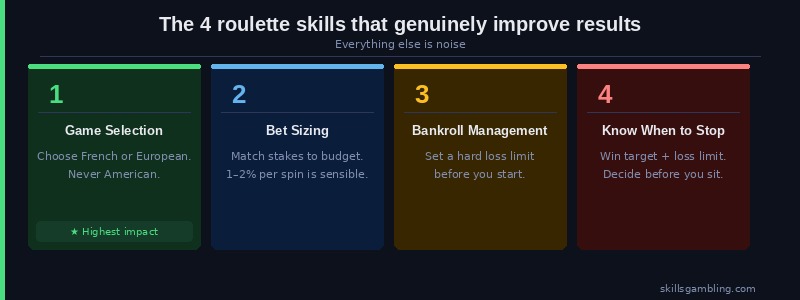
Table of Contents
- What Roulette Skills Actually Are
- Skill 1: Game Selection — The Most Valuable Decision You Make
- Skill 2: Bet Selection — Managing Risk Without Changing the Odds
- Skill 3: Bankroll Management — Making Your Budget Last
- Skill 4: Knowing When to Stop
- The Skills That Don’t Exist in Roulette
- How Roulette Skills Compare to Other Casino Games
- Responsible Gambling
- FAQ
What Roulette Skills Actually Are
Let’s be direct about something most roulette guides won’t say clearly: roulette is primarily a game of luck. The outcome of every spin is determined by physics — the speed of the wheel, the trajectory of the ball, the position of the deflectors. No player decision changes any of that.
What makes roulette interesting from a skill perspective is everything that surrounds the spin. The decisions you make before you sit down, while you’re choosing bets, and during the session have a measurable effect on your results over time. Not on individual spins — on the overall cost and experience of playing.
“Roulette skill isn’t about predicting the wheel. It’s about making every decision around the wheel as good as possible.”
The four genuine roulette skills are:
- Which variant you play
- Which bets you place
- How much you stake
- When you walk away
That’s it. Everything else — lucky numbers, betting systems, pattern recognition, timing the croupier — falls into the category of things that feel like skill but produce no measurable improvement in results.
For the complete mathematical foundation behind why this is the case, see our full guide to online roulette.
Skill 1: Game Selection — The Most Valuable Decision You Make
This is the single highest-impact roulette skill, and it requires zero time at the table. It happens before you place a single chip.
Three main variants exist. Their house edges — the mathematical advantage the casino holds on every bet — are dramatically different:
| Variant | House Edge | RTP |
|---|---|---|
| French Roulette (La Partage) | 1.35% on even-money bets | 98.65% |
| European Roulette | 2.70% | 97.30% |
| American Roulette | 5.26% | 94.74% |
What this means in practice: playing 100 rounds at £10 per spin, the expected cost is:
- French roulette: £13.50
- European roulette: £27.00
- American roulette: £52.60
Same game. Same enjoyment. Nearly four times the cost difference between the best and worst choice.
Choosing French roulette over American roulette on even-money bets is worth more than any betting system, strategy, or lucky number ever invented.
What Makes French Roulette Different
French roulette uses a single-zero wheel — identical to European — but adds one critical rule: La Partage. When the ball lands on zero, even-money bets (Red/Black, Odd/Even, High/Low) return half your stake rather than losing the full amount. This single rule cuts the house edge on those bets in half.
Some tables offer En Prison instead — your even-money bet stays on the table for one more spin rather than losing when zero appears. Mathematically identical to La Partage over time.
How to Find the Best Game Online
In online casino lobbies, look for:
- French Roulette in the live casino or table games section
- Confirm the rules include La Partage or En Prison before sitting down
- If French isn’t available, European Roulette is always the correct second choice
- Avoid American Roulette whenever either alternative exists
This game selection skill compounds over every session you play. It’s the most straightforward and most impactful roulette decision available.
Skill 2: Bet Selection — Managing Risk Without Changing the Odds
Here’s a fact that surprises many players: every standard bet on a European roulette wheel carries the same 2.70% house edge. Whether you bet on a single number, a colour, a dozen, or an even-money outcome — the mathematical expectation is identical.
This means bet selection isn’t about finding a “better” bet. It’s about choosing a variance profile that matches your bankroll and how you want the session to feel.
Inside Bets vs Outside Bets
Inside bets cover small groups of numbers and pay large amounts when they win:
- Straight up (1 number): pays 35:1, wins 2.7% of spins
- Split (2 numbers): pays 17:1, wins 5.4% of spins
- Corner (4 numbers): pays 8:1, wins 10.8% of spins
Outside bets cover large portions of the wheel and win frequently:
- Red/Black: pays 1:1, wins 48.6% of spins
- Dozens/Columns: pays 2:1, wins 32.4% of spins
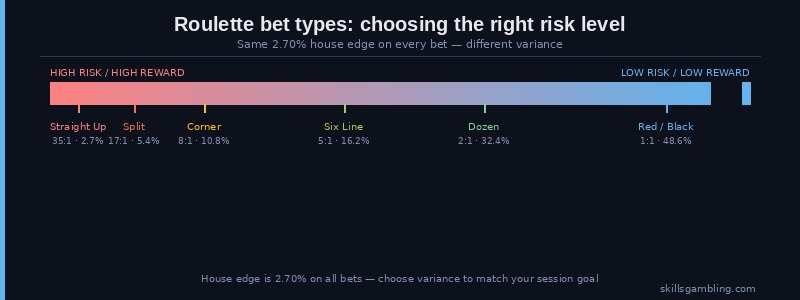
The skill: matching your bet type to your session goal.
If you have a small budget and want to maximise playing time, outside bets produce smoother results — you win often, lose in small amounts, and your session budget extends further. If you want the possibility of a significant win from a small stake, inside bets on individual numbers deliver that — at the cost of longer losing runs between wins.
Neither approach is mathematically superior. Both carry 2.70% house edge. The skill is making the choice deliberately, based on your actual goals, rather than defaulting to whatever feels exciting.
The One Bet to Always Avoid
Skill 3: Bankroll Management — Making Your Budget Last
If you ever play American roulette, the five-number top-line bet covering 0, 00, 1, 2, and 3 carries a house edge of 7.89% — structurally worse than any other standard roulette bet. It’s the only bet on the table that breaks the consistency of the house edge. Never place it.
Bankroll management is the roulette skill that determines whether a losing session stays manageable or becomes damaging. It’s not exciting — but it’s the difference between leaving with a planned loss and leaving having spent far more than you intended.
The principles applied to roulette connect directly to how professional gamblers approach stake sizing across all forms of gambling.
Set Your Session Budget Before You Open the Game
Decide the maximum you will lose in this session before you start. This isn’t your deposit balance — it’s a specific amount you’re comfortable spending for the entertainment of playing. Once it’s gone, the session ends.
This decision needs to happen before you sit down because variance will create moments during almost any session where you’re ahead — and the temptation to “keep going while you’re winning” or “chase back to even” is powerful in the moment. A predetermined hard limit removes those decisions entirely.
Stake Sizing Relative to Your Budget
A practical starting point:
- Conservative play: 1% of session budget per spin — gives you 100 spins minimum
- Moderate play: 2% of session budget per spin — gives you 50 spins minimum
- Higher variance: 5% of session budget per spin — gives you 20 spins minimum
At 2.70% house edge on European roulette, the expected loss over 50 spins at 2% stake sizing is approximately 2.7% of your session budget. In practice, variance means the actual result could be significantly higher or lower. The point is having enough spins for the session to develop rather than going broke in the first fifteen minutes.
Game Speed and Hourly Exposure
Standard live dealer roulette produces 40–50 spins per hour. Auto Roulette and Speed Roulette can reach 80+ spins per hour.
At the same stake per spin, a faster game doubles your hourly exposure to the house edge. If you switch to a faster variant, either reduce your stake proportionally or accept the higher hourly cost consciously.
For a comprehensive approach to stake sizing across all gambling games, bankroll management principles covers the full framework including Kelly Criterion and session structuring.
Skill 4: Knowing When to Stop
This is the roulette skill nobody talks about because it’s the hardest one psychologically.
Roulette produces variance — natural swings of wins and losses around the mathematical expectation. During any session, you will be significantly up at some point, and you will be significantly down at some point. Knowing when to stop requires making decisions in advance and holding to them under conditions specifically designed to make you keep playing.
Win Targets
Setting a win target — “I’ll stop if I’m up 50% of my session budget” — sounds arbitrary. It isn’t. Variance means you will be in profit at some point in many sessions. The ability to leave while ahead is a genuine skill that requires a prior commitment, because in the moment, the natural instinct is always to continue.
Loss Limits
Your session loss limit is non-negotiable. When it’s gone, the session ends — regardless of whether you feel unlucky, think you’re “due” a win, or want to recover what you’ve lost.
Chasing losses is the single most expensive behaviour in roulette. It turns a manageable planned loss into an unplanned and often much larger one. How variance actually works in gambling explains precisely why the feeling of being “due” a win after losses is a cognitive error, not a pattern.
Fatigue and Decision Quality
Decision quality deteriorates with fatigue. Long roulette sessions — particularly late at night or after alcohol — produce worse decisions about stake sizing, bet selection, and when to stop. Setting a time limit alongside a loss limit is a legitimate skill decision, not a sign of weakness.
The Skills That Don’t Exist in Roulette
Being honest about what doesn’t work is as important as understanding what does.
Betting Systems
The Martingale, Fibonacci, D’Alembert, Labouchère — every progression system ever invented makes the same implicit promise: that by structuring your bets in a specific pattern, you can improve your results. None of them can.
Each spin is mathematically independent. The wheel has no memory of previous results. No sequence of bets changes the 2.70% house edge on European roulette. What betting systems do change is the distribution of wins and losses — some produce more frequent small wins with occasional large losses; others do the reverse. Expected value per pound wagered: unchanged.
“Hot” and “Cold” Numbers
The roulette display panels showing recent results, hot numbers, and cold numbers are entertainment features — not analytical tools. A number that hasn’t appeared in 50 spins has exactly the same 1/37 probability of appearing on the next spin as every other number. Previous outcomes carry no information about future outcomes. This is not a theory — it’s a mathematical property of independent random events.
Timing the Croupier
The idea that observing a dealer’s release point or ball speed reveals patterns is occasionally relevant on poorly maintained physical wheels with worn equipment. In online live dealer environments, providers use precision-engineered wheels, certified randomness testing, and rotating dealer protocols. No exploitable pattern exists in regulated online roulette.
Lucky Numbers
Numerologically significant numbers — birthdays, anniversaries, player favourites — have exactly the same probability of winning as any other number. Betting on 17 because it’s statistically the most popular straight-up choice at roulette tables worldwide gives you no advantage whatsoever.
How Roulette Skills Compare to Other Casino Games
Understanding where roulette sits relative to other games helps put its skill dimension in perspective.
| Game | Skill Influence | House Edge (optimal play) | Long-Run Player Edge Possible? |
|---|---|---|---|
| Poker* | Very high | Variable (rake only) | Yes |
| Blackjack (basic strategy) | High | 0.4–0.6% | No (marginal with counting) |
| Sports Betting (sharp) | High | Variable | Yes (rare) |
| French Roulette | Low-moderate | 1.35% | No |
| European Roulette | Low | 2.70% | No |
| Baccarat | Very low | 1.06% (Banker) | No |
| American Roulette | Very low | 5.26% | No |
| Slots | Minimal | Varies (2–6% typical) | No |
Roulette sits in an honest middle position. It’s not a game where skill produces a player edge — the house always retains its mathematical advantage. But it’s also not a game where all decisions are equal. The skills above produce a real, measurable difference in how much you spend per session and how long your money lasts.
For how this compares to the game where skill has the most dramatic effect, blackjack basic strategy demonstrates what skill-driven house edge reduction looks like when decisions directly affect mathematical outcomes.
*For a complete breakdown of poker strategy from first principles, see our poker strategy guide.
Responsible Gambling
No roulette skill eliminates the house edge. All roulette involves financial risk. Past results — including winning sessions — do not predict future results.
The skills in this guide reduce how much roulette costs per session. They do not make roulette a profitable activity over time.
If gambling stops feeling like entertainment and starts feeling like something you need to do — to recover losses, to escape stress, or because you can’t stop — please use these resources:
- GamCare (UK): gamcare.org.uk / 0808 8020 133 (free, 24/7)
- BeGambleAware: begambleaware.org
- GAMSTOP (UK self-exclusion): gamstop.co.uk
- National Problem Gambling Helpline (US): 1-800-522-4700
FAQ
Can skill actually improve roulette results?
Yes — within limits. Skill influences game selection (choosing French over American saves significant house edge), bet sizing (matching stakes to bankroll prevents going broke before variance evens out), and session discipline (stopping at a predetermined limit prevents chasing losses). Skill does not influence where the ball lands on any given spin.
Which roulette bet has the best odds?
All standard bets on a European single-zero wheel carry the same 2.70% house edge, so no standard bet is mathematically better than another. The closest thing to a genuinely better bet is an even-money wager (Red/Black, Odd/Even, High/Low) on a French roulette table with La Partage — that carries a 1.35% house edge, the lowest available in standard roulette.
Do betting systems like the Martingale work?
No betting system changes the expected value of roulette bets. The Martingale doubles your bet after each loss, which recovers previous losses when you eventually win — but requires exponentially growing bets that quickly hit table limits or exceed bankroll during a losing streak. The house edge remains 2.70% on every spin regardless of your staking pattern.
Is European roulette better than American?
Yes, always — when both are available. European roulette has one zero pocket (37 total), giving a house edge of 2.70%. American roulette has two zero pockets (38 total), giving 5.26%. The payouts are identical in both games, so the extra pocket in American roulette is pure additional cost with no benefit to the player.
What is the best roulette strategy for beginners?
Three things cover the most important ground: play European or French roulette (never American), bet even-money outside bets (Red/Black, Odd/Even) to extend your playing time, and set a hard loss limit before you start. These three decisions address game selection, variance management, and session discipline — the areas where skill has genuine impact.
Does it matter how long I play roulette?
Yes — in the sense that longer sessions mean more spins, which means more exposure to the house edge. The expected loss grows with time. Setting a session time limit alongside a loss limit is a practical skill that prevents extended play from turning a planned entertainment spend into an unplanned large loss.
Conclusion
Roulette is an honest game. It doesn’t pretend the odds are in your favour, and it rewards players who approach it clearly rather than hopefully.
The four skills that genuinely matter — choosing the right variant, selecting bets deliberately, managing your stakes, and stopping at predetermined limits — are available to every player before they even sit down. They require no special knowledge, no system, and no luck. Just clear decisions made in advance.
That’s what roulette skill actually looks like. It’s less glamorous than a secret system. It’s also the only version that works.
Related Reading
- Online Roulette: The Definitive Guide to Playing Smarter
- How the House Edge Works Across Every Casino Game
- Bankroll Management: The Strategy That Protects Every Other Strategy
- Skill vs Luck: What Actually Determines Your Results
- Blackjack Basic Strategy Chart: The Definitive Guide
- How Professional Gamblers Think Differently
SkillsGambling.com is an educational resource. Nothing published here constitutes financial advice or a guarantee of gambling outcomes. Gambling involves financial risk. Please gamble responsibly. 18+ only.