
Quick Answer: The blackjack basic strategy chart is the mathematically correct decision for every possible hand combination. Played perfectly, following the blackjack basic strategy chart reduces the house edge to 0.4–0.6% depending on table rules — down from 2–4% for players making intuitive decisions. The chart below covers all hard hands, soft hands, and pairs for standard multi-deck games. Use it as a reference at the table, or memorise it section by section using the method in this guide.
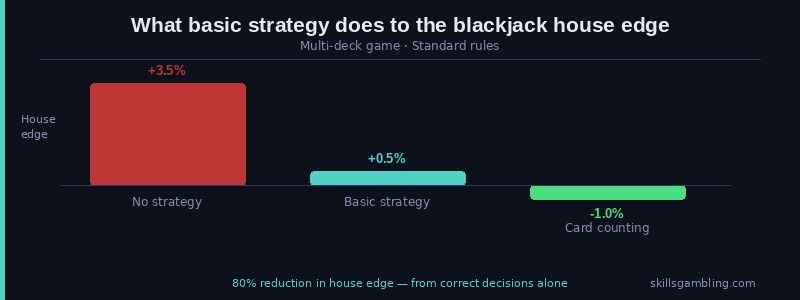
Table of Contents
- How to Read the Strategy Chart
- The Interactive Basic Strategy Chart
- Hard Hands: The Foundation of Basic Strategy
- Soft Hands: Why the Ace Changes Everything
- Pair Splitting: The Most Misunderstood Decisions
- Surrender: The Underused Power Move
- How Rules Affect the Chart (and the House Edge)
- How to Memorise Basic Strategy
- Common Mistakes That Cost Players Money
- Basic Strategy vs Card Counting: What’s the Difference?
- Responsible Gambling
- FAQ
How to Read the Blackjack Basic Strategy Chart
Every cell in the chart represents a decision. You need two pieces of information:
- Your hand total — shown on the left column
- The dealer’s upcard — shown across the top row
Find where those two values intersect. The cell tells you the correct play:
| Symbol | Action | What It Means |
|---|---|---|
| H | Hit | Take another card |
| S | Stand | Take no more cards |
| D | Double Down | Double your bet, take exactly one card |
| DS | Double or Stand | Double if allowed; otherwise stand |
| SP | Split | Split the pair into two hands |
| SU | Surrender | Give up half your bet, exit the hand |
“The chart isn’t a suggestion. Every cell is the result of computer simulation across hundreds of millions of hands. It’s the answer — not a starting point for debate.
The Interactive Basic Strategy Chart
See the separate interactive chart file for the fully clickable, colour-coded strategy tool.
Standard multi-deck chart (4–8 decks, dealer stands on soft 17, double after split allowed, late surrender available):
Hard Hands
| Your Hand | 2 | 3 | 4 | 5 | 6 | 7 | 8 | 9 | 10 | A |
|---|---|---|---|---|---|---|---|---|---|---|
| Hard 5–8 | H | H | H | H | H | H | H | H | H | H |
| Hard 9 | H | D | D | D | D | H | H | H | H | H |
| Hard 10 | D | D | D | D | D | D | D | D | H | H |
| Hard 11 | D | D | D | D | D | D | D | D | D | H |
| Hard 12 | H | H | S | S | S | H | H | H | H | H |
| Hard 13 | S | S | S | S | S | H | H | H | H | H |
| Hard 14 | S | S | S | S | S | H | H | H | H | H |
| Hard 15 | S | S | S | S | S | H | H | H | SU | H |
| Hard 16 | S | S | S | S | S | H | H | SU | SU | SU |
| Hard 17+ | S | S | S | S | S | S | S | S | S | S |
Soft Hands (Ace counted as 11)
| Your Hand | 2 | 3 | 4 | 5 | 6 | 7 | 8 | 9 | 10 | A |
|---|---|---|---|---|---|---|---|---|---|---|
| A,2 (Soft 13) | H | H | H | D | D | H | H | H | H | H |
| A,3 (Soft 14) | H | H | H | D | D | H | H | H | H | H |
| A,4 (Soft 15) | H | H | D | D | D | H | H | H | H | H |
| A,5 (Soft 16) | H | H | D | D | D | H | H | H | H | H |
| A,6 (Soft 17) | H | D | D | D | D | H | H | H | H | H |
| A,7 (Soft 18) | DS | DS | DS | DS | DS | S | S | H | H | H |
| A,8 (Soft 19) | S | S | S | S | DS | S | S | S | S | S |
| A,9 (Soft 20) | S | S | S | S | S | S | S | S | S | S |
Pair Splitting
| Your Pair | 2 | 3 | 4 | 5 | 6 | 7 | 8 | 9 | 10 | A |
|---|---|---|---|---|---|---|---|---|---|---|
| 2,2 | SP | SP | SP | SP | SP | SP | H | H | H | H |
| 3,3 | SP | SP | SP | SP | SP | SP | H | H | H | H |
| 4,4 | H | H | H | SP | SP | H | H | H | H | H |
| 5,5 | D | D | D | D | D | D | D | D | H | H |
| 6,6 | SP | SP | SP | SP | SP | H | H | H | H | H |
| 7,7 | SP | SP | SP | SP | SP | SP | H | H | H | H |
| 8,8 | SP | SP | SP | SP | SP | SP | SP | SP | SP | SP |
| 9,9 | SP | SP | SP | SP | SP | S | SP | SP | S | S |
| 10,10 | S | S | S | S | S | S | S | S | S | S |
| A,A | SP | SP | SP | SP | SP | SP | SP | SP | SP | SP |
Hard Hands: The Foundation of Basic Strategy
A hard hand is any hand that either contains no ace, or contains an ace that can only be counted as 1 (because counting it as 11 would bust you).
Hard hands are the most common situation you face at the blackjack table. Getting these right is the single biggest improvement most players can make.
The Logic Behind Hard Hand Decisions
Basic strategy for hard hands is built around one central insight: the dealer’s upcard tells you how likely the dealer is to bust.
When the dealer shows a 2, 3, 4, 5, or 6 — these are bust cards. The dealer must hit to 17 and stands a meaningful chance of going over 21. Against a bust card, you play conservatively: stand on hands you might otherwise hit, because you want the dealer to take the risk of busting.
When the dealer shows a 7, 8, 9, 10, or Ace — these are strong upcards. The dealer is likely to make a strong hand. You need to be more aggressive: hit weaker hands, take doubles when your total is strong, because standing on 15 or 16 against a dealer 9 is just handing them money more slowly.
Key Hard Hand Rules to Know Cold
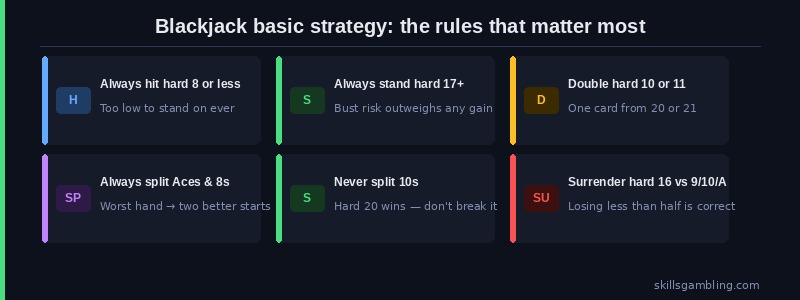
Always stand on hard 17 or higher. No exceptions. The risk of busting outweighs any potential gain from hitting. This applies even against a dealer Ace.
Hard 16 vs dealer 9, 10, or Ace — surrender if available. This is statistically the worst hand in blackjack. When surrender is available, giving up half your bet is the correct play. When it isn’t, hit.
Hard 12 vs dealer 4, 5, 6 — stand. This surprises many players. Standing on 12 against a dealer bust card is correct even though 12 feels fragile. You’re waiting for the dealer to bust.
Hard 9 vs dealer 3–6 — double down. Not against 2. The dealer’s 2 is a bust card but a weaker one than 3–6, and the potential gain from doubling doesn’t justify it when your 9 needs a 10-value card to be truly strong.
Hard 10 or 11 — double down against almost everything. These are your strongest starting positions. You’re one card from 20 or 21. Double and take the value.
“Most players stand too often on soft hands and hit too often on hard ones. The chart corrects both errors — but only if you actually follow it.”
Soft Hands: Why the Ace Changes Everything
A soft hand contains an ace that’s currently counted as 11 without risk of busting. It’s called “soft” because you can take a card without any risk: if the result would bust you, the ace simply drops to 1.
Soft hands are where many recreational players leave the most money on the table, because the instinct to “protect” a decent hand overrides the correct aggressive play.
The Soft 17 Problem
Soft 17 (Ace-6) should be hit or doubled — never stood on.
This goes against most people’s instincts. You have 17. That feels like a decent hand. But soft 17 is a weak hand with hidden potential. Hitting or doubling gives you:
- Any Ace through 4: you make a better hand (18–21)
- Any 5: you hit exactly 12 — then continue following basic strategy
- Any 6 or 7: you’re at 13 or 14 (ace drops to 1) — continue hitting
- Any 8, 9, 10: you end up at 15, 16, or 17 with ace as 1
The point: you cannot bust from soft 17 on one card. The risk of hitting is zero. The potential gain is real.
Against dealer 3–6, double down on soft 17. Against 2, 7, or 8, hit. Against 9, 10, or Ace, hit.
Soft 18: The Most Misplayed Hand in Blackjack
Soft 18 (Ace-7) against dealer 9, 10, or Ace — hit, not stand.
18 feels strong. Statistically, it isn’t strong enough against dealer power cards. The dealer will make 19+ a significant percentage of the time from those upcards. Soft 18 loses those hands. Hitting gives you a chance at 19, 20, or 21.
Against 2, 7, or 8 — stand. Against 3, 4, 5, or 6 — double down. You have a strong soft hand, the dealer has a bust card, and doubling extracts maximum value from an excellent situation.
The correct play on soft hands is the area where following the chart — rather than intuition — produces the largest single improvement for most players.
Pair Splitting: The Most Misunderstood Decisions
When your first two cards are a pair, you have the option to split them into two separate hands, each with its own bet equal to your original stake.
The splitting decisions are worth knowing precisely because the swings are significant — both in terms of money at risk and expected value.
The Absolute Rules (Never Deviate)
Always split Aces. Two separate hands each starting with an Ace is enormously better than a soft 12. The catch: most casinos only deal one card to each split Ace. Accept it. Still always split.
Always split 8s. Hard 16 is the worst hand in blackjack. Two separate hands starting at 8 gives you far better situations. Even against an Ace — where 8,8 vs Ace looks frightening — splitting is correct. Yes, you might make two losing hands. You’d have almost certainly lost the one hard 16.
Never split 10s. You have 20. That wins most hands. Splitting transforms a near-certain winner into two separate uncertain hands. The maths are unambiguous.
Never split 5s. Hard 10 is an excellent double-down hand. Two separate hands starting at 5 are mediocre. Treat 5,5 like hard 10 and double.
Situational Splits
Nines: Split against 2–6 and 8–9. Stand against 7, 10, and Ace. The logic: against a dealer 7, your 18 likely wins. Split and you risk ending up with two weaker hands. Against 8 or 9, you need to improve — split.
Sixes: Split against dealer 2–6 only. Against 7 or higher the dealer is too strong and your 6s need to stand on their own.
Fours: Only split against dealer 5 or 6 — the two weakest upcards. Everywhere else, treat 4,4 as hard 8 and hit.
Twos and Threes: Split against 2–7, hit against everything else.
Surrender: The Underused Power Move
Late surrender allows you to give up half your bet after seeing the dealer’s upcard, before the dealer checks for blackjack. It’s available at many online casinos and some land-based tables.
Most players never surrender, viewing it as giving up. It isn’t. It’s the mathematically correct play when your expected loss from continuing exceeds 50 cents per pound staked.
When to Surrender
Hard 16 vs dealer 9, 10, or Ace. This is the most important surrender situation. Hard 16 is the worst starting position in blackjack. Hitting loses more than 50% of the time from these upcards. Surrendering is cheaper.
Hard 15 vs dealer 10. Your expected loss on hard 15 against a 10 exceeds 50%, making surrender the correct play.
Hard 17 vs dealer Ace (in casinos where dealer hits soft 17). This is a rare edge case — standard charts for S17 tables don’t include this. Verify your table’s specific rules.
“Surrendering 16 against a dealer 10 feels like defeat. Statistically, it’s the only winning move available.”
How Rules Affect the Chart (and the House Edge)
Basic strategy isn’t universal. The correct play changes with the rules of the specific game you’re playing. More importantly, rule selection is itself a skill — choosing the right table before sitting down is worth more than perfect execution at the wrong table.
Rule Impact on House Edge
| Rule | Effect on House Edge |
|---|---|
| Blackjack pays 3:2 | Baseline — always seek this |
| Blackjack pays 6:5 | +1.39% to house edge |
| Dealer stands on soft 17 (S17) | Better for player (~−0.20%) |
| Dealer hits soft 17 (H17) | +0.20% to house edge |
| Double after split allowed | −0.14% (player benefit) |
| Late surrender available | −0.08% (player benefit) |
| Single deck | −0.48% vs 6-deck (but often offset by worse payouts) |
| 6-deck shoe | Baseline for most strategy charts |
| Re-splitting aces allowed | −0.07% (player benefit) |
The single most impactful rule is blackjack payout. Never play 6:5 blackjack if a 3:2 table is available. The 1.39% edge increase from 6:5 erases every advantage basic strategy provides.
How Chart Decisions Change by Rules
A few specific plays differ between H17 and S17 games:
- Soft 18 (A,7) vs dealer Ace — stand in S17, hit in H17
- Hard 11 vs dealer Ace — stand in S17, double in H17
- Soft 19 (A,8) vs dealer 6 — stand in S17, double in H17
For casual players, use the multi-deck S17 chart (which this guide presents) as your default. If you’re playing regularly at a specific casino, find the exact chart for their rules — the differences are small but real.
Understanding how the house edge is built into every casino game is the foundation that makes these rule comparisons meaningful.
How to Memorise Basic Strategy
The chart has around 250 cells. That sounds intimidating. In practice, most of those cells follow simple patterns, and perhaps 30–40 cells are the ones that actually require deliberate memorisation.
The Layered Approach
Start with the non-negotiables (5 minutes):
These never change regardless of rules:
- Always split Aces and 8s
- Never split 10s or 5s
- Always stand on hard 17+
- Always hit hard 8 or less
- Never take insurance
Learn hard hands by dealer upcard group (20–30 minutes):
Think in two zones — dealer bust cards (2–6) vs dealer power cards (7–Ace). Against bust cards, stand more. Against power cards, hit more. The specific cutoffs (stand 12+ vs 4–6, stand 13+ vs 2–3) are the details to nail down.
Tackle soft hands next (15–20 minutes):
The key principle: you can’t bust, so be aggressive. Know the double-down situations (A,6 and below vs 3–6; A,7 vs 3–6; A,8 vs 6). Know when to hit soft 18 (vs 9, 10, Ace).
Pairs last (15 minutes):
The absolute rules (always Aces, always 8s, never 10s, never 5s) cover the high-stakes decisions. The rest follow logical patterns based on the dealer’s bust card zones.
Practice Tools
- Flashcard apps — apps like Anki let you run through hand scenarios repeatedly
- Free online trainers — several sites offer blackjack trainers that flag mistakes in real time
- Kitchen table practice — deal hands to yourself and apply the chart until decisions become automatic
- Print and carry — most casinos allow a strategy card at the table. Use it until you don’t need it
The goal is automaticity — making correct decisions without calculation. Under casino conditions (noise, conversation, alcohol, time pressure) you need the plays to be reflexive, not deliberate.
Common Mistakes That Cost Players Money
These are the highest-frequency errors real players make — the ones basic strategy eliminates.
Mistake 1: Standing on Soft 17
The misconception: “I have 17, that’s a decent hand.” The reality: Soft 17 cannot bust on one card. Standing gives you one possible outcome. Hitting or doubling gives you the chance to improve. The cost: Players who stand on soft 17 face an extra 0.2–0.4% house edge on those hands.
Mistake 2: Not Splitting 8s Against High Cards
The misconception: “The dealer has a 10, splitting puts more money at risk.” The reality: Hard 16 against a 10 loses approximately 77% of the time. Two hands starting at 8 are each meaningfully stronger. You’ll likely still lose money — but less of it. The cost: Refusing to split 8s against strong dealer cards is one of the most expensive errors at the blackjack table.
Mistake 3: Taking Insurance
The misconception: “Insurance protects my good hand against dealer blackjack.” The reality: Insurance is a separate side bet on whether the dealer has a 10 in the hole. It pays 2:1 but the true odds are approximately 2.25:1 against. Insurance has a house edge of around 7.4% — many times worse than any basic strategy play. The rule: Never take insurance. “Even money” on a blackjack vs dealer Ace is also insurance in disguise. Decline it.
Mistake 4: Mimicking the Dealer
The misconception: “The dealer always hits below 17, so I should too.” The reality: The dealer follows fixed rules that don’t adjust to the situation. You have information the dealer doesn’t respond to — their upcard. Basic strategy exploits that information. Mimicking the dealer wastes it entirely and adds approximately 5.5% to the house edge.
Mistake 5: Chasing with Bad Doubles
The misconception: After a losing streak, doubling on weaker totals to “get back quicker.” The reality: Doubling on a hard 6 against a dealer 8 because you’ve “been unlucky” is an emotional decision with terrible expected value. The house edge on that bet is brutal. Research on cognitive distortions in gambling confirms that chasing losses is one of the most reliably documented decision-making errors under variance pressure. Understanding how variance actually works in gambling is what separates disciplined players from loss-chasers.
Basic Strategy vs Card Counting: What’s the Difference?
Basic strategy and card counting are often confused or conflated. They’re related but serve different purposes.
Basic strategy is the correct decision for each hand based solely on your cards and the dealer’s upcard, assuming a full shoe with no count information. It’s fixed, learnable, and reduces the house edge to its minimum for a given rule set. Basic strategy is available to any player who learns it.
Card counting tracks the ratio of high cards to low cards remaining in the shoe. A high-count shoe (rich in tens and aces) shifts the mathematical advantage toward the player: blackjacks occur more frequently, doubles and splits become more profitable, and the dealer busts more often. Card counters raise their bets when the count is high and lower them when it’s low.
Basic strategy is the foundation. Card counting is an additional layer built on top of it — you cannot count cards effectively without first having basic strategy fully memorised.
A player using basic strategy alone faces a house edge of approximately 0.4–0.6%. A skilled card counter operating in favourable conditions might achieve a player edge of 0.5–1.5%. The gap isn’t enormous — but it’s the difference between a long-run losing game and a theoretically winning one.
Card counting is legal. It’s not cheating. It’s using available information — the same information visible to any player at the table. Casinos can and do counter it through shuffling frequency, deck penetration limits, and asking skilled players to leave.
For a detailed look at the decision-making frameworks that connect basic strategy to more advanced play, see how professional gamblers approach decisions differently.
Responsible Gambling
Basic strategy reduces the house edge. It does not eliminate it. In a 0.5% house edge game, the casino still expects to retain 50p of every £100 wagered over time. Basic strategy makes blackjack one of the best-value casino games available — it does not make it a profitable activity.
No gambling strategy guarantees profit. All gambling involves financial risk. Past results — including winning sessions played with perfect basic strategy — do not predict future results.
Play Within Defined Limits
- Set a session loss limit before you sit down and treat it as absolute
- Decide your bet size based on bankroll management principles — never bet more than 1–2% of your total gambling bankroll on any single hand
- Set a time limit — decision quality deteriorates with fatigue, and casinos are designed to make time feel compressed
Recognise the Signs
If gambling is causing financial pressure, affecting relationships, or feels compulsive rather than recreational, please use the support resources available:
- GamCare: gamcare.org.uk / 0808 8020 133
- BeGambleAware: begambleaware.org
- National Problem Gambling Helpline (US): 1-800-522-4700
FAQ
Does basic strategy actually work?
Yes — in the sense that it gives you the mathematically optimal decision for every hand. Using perfect basic strategy reduces the house edge from 2–4% (intuitive play) to approximately 0.4–0.6%. Over any given session, results vary due to variance. Over thousands of hands, the statistical difference becomes measurable and meaningful.
Can I use a strategy card at the casino?
At most land-based casinos, yes — strategy cards are permitted at the table. You can check in advance or simply ask the dealer. Online, you can keep the chart on a separate screen. Using basic strategy is not cheating in any form.
Does basic strategy change based on deck count?
Yes, slightly. The chart in this guide is calibrated for multi-deck games (4–8 decks), which cover the vast majority of blackjack played in casinos and online. Single-deck games have a few different optimal plays, primarily around doubling decisions. If you regularly play single-deck, seek a specific single-deck chart.
Should I always follow the chart even when it feels wrong?
Yes. The chart represents the result of simulating hundreds of millions of hands. Your gut feeling is based on recent experience and cognitive biases. The chart is almost always right; your gut is frequently wrong. The entire point of basic strategy is to replace intuition with mathematics.
What is the difference between hard and soft hands?
A soft hand contains an Ace that’s currently counting as 11. It’s “soft” because taking a card can’t bust you — if the result would go over 21, the Ace drops to 1. A hard hand either contains no Ace, or an Ace that can only count as 1 without busting. Hard hands require more caution on high totals because busting is a real risk.
Is 6:5 blackjack worth playing with basic strategy?
No. The 6:5 payout rule increases the house edge by approximately 1.39 percentage points. This more than doubles the typical house edge on a well-played multi-deck game. If a 3:2 blackjack table is available anywhere in the casino, play there instead. 6:5 blackjack is one of the few table games where the rule variation genuinely changes whether the game is worth playing.
What about side bets — does basic strategy cover those?
Basic strategy doesn’t cover side bets because side bets are independent wagers with their own fixed house edges. Most blackjack side bets (Perfect Pairs, 21+3, Lucky Lucky) carry house edges of 3–10% or higher. The answer from a skill-based gambling perspective is straightforward: avoid them. They add entertainment value and cost real money.
How long does it take to learn basic strategy?
The basics — hard hand rules, the absolute split rules, soft hand principles — can be functional within a few hours of study. Perfect memorisation (automatic responses to every situation without reference) typically takes 10–20 hours of focused practice. Using a strategy card at the table while you learn is entirely reasonable and actively encouraged.
Conclusion
Basic strategy is the most accessible skill in gambling. A few hours of study, a printable chart, and the discipline to follow it — that’s all it takes to cut the house edge by 80% compared to intuitive play.
It won’t make blackjack a winning game in the long run. The house still holds an edge of 0.4–0.6% against even a perfect basic strategy player. But it makes blackjack the best-value house-banked casino game available, and it’s the foundation for anyone who wants to move toward more advanced play.
The order of priority is simple:
- Rule selection first — find a 3:2 blackjack table, dealer stands on soft 17, double after split allowed. Table rules determine your starting disadvantage before you play a single hand.
- Basic strategy second — follow the chart precisely, every hand, without exception.
- Bankroll management third — protecting your money with structured bet sizing ensures a single bad run doesn’t end your session prematurely.
Master those three and you’re playing the game as well as it can be played without card counting. That puts you ahead of the overwhelming majority of players at any blackjack table you’ll sit at.
Related Reading
- What Is the House Edge and How Does It Work?
- Can Skill Overcome the House Edge?
- Advanced Blackjack Strategy: Techniques for Experienced Players
- Bankroll Management: The Strategy That Protects Every Other Strategy
- How Professional Gamblers Think Differently
- Expected Value in Gambling: The Complete Guide
- Skill vs Luck: What Actually Determines Your Results
SkillsGambling.com is an educational resource. Nothing published here constitutes financial advice or a guarantee of gambling outcomes. Gambling involves financial risk. Please gamble responsibly. 18+ only.