
Quick Answer
Professional gamblers don’t think about gambling the way recreational players do. The difference isn’t primarily knowledge — it’s framework. Professionals evaluate decisions by their mathematical quality, not by their outcomes. They accept variance as a permanent feature rather than an injustice to overcome. They track everything, adjust nothing based on feelings, and size bets according to edge rather than confidence. Most importantly, they separate the quality of a decision from the result it produces — a distinction that recreational players almost never make, and professionals never abandon.
Introduction
Most people assume professional gamblers are simply better at predicting outcomes. Better at reading hands. Better at picking winners. Better at knowing when the ball will land on red.
Some of that is true — but it’s not the main thing. The main thing is something less obvious and considerably harder to develop: a completely different way of evaluating decisions.
Recreational players judge decisions by what happens next. The call was good because they won. The fold was wrong because the card came. The sports bet was smart because it paid out. Every decision is evaluated in the rear-view mirror, through the lens of whatever the result happened to be.
Professional gamblers judge decisions by something else entirely: whether the decision was mathematically correct at the moment it was made, independent of what followed.
That shift — from results-based thinking to process-based thinking — is the single most important distinction between the two groups. Everything else flows from it.
This guide breaks down the core mental frameworks that professional gamblers use, why they work, and what it actually takes to develop them.
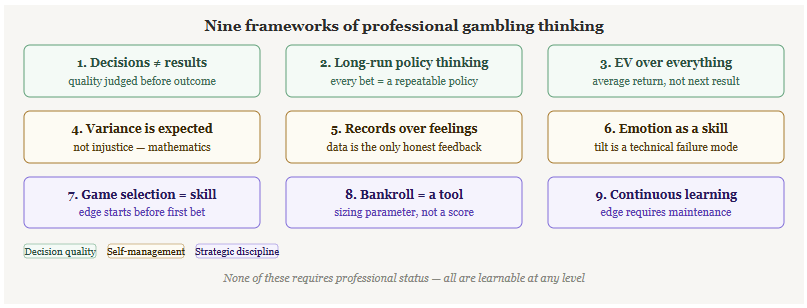
Framework 1: Decisions and Results Are Two Different Things
The foundational professional insight is one that sounds simple and proves genuinely difficult to internalise:
A good decision can produce a bad result. A bad decision can produce a good result. The result tells you nothing reliable about the quality of the decision.
In any gambling activity involving variance — which is all of them — short-run outcomes are dominated by randomness. A poker player who calls correctly with 70% equity loses 30% of the time. A sports bettor who finds genuine value at 3.00 loses the bet two-thirds of the time. A blackjack player who doubles down correctly still loses the hand regularly.
The outcome of a single instance proves nothing about whether the decision was right.
Recreational players understand this intellectually. They don’t apply it in practice. After a fold that would have won, they second-guess. After a call that lost, they reconsider their read. After a bet that didn’t come in, they question their analysis. They’re constantly revising strategy based on results — which, in the short run, are mostly noise.
Professionals apply a different test. Before the result is known, they ask: “Is this the correct decision given the available information?” After the result, they evaluate: “Was my reasoning sound?” If both answers are yes, a losing outcome changes nothing. If either answer is no, a winning outcome doesn’t validate anything either.
The Practical Implication
This framework has a direct practical consequence: professionals don’t tilt.
Tilt — the emotional deterioration of decision quality following bad outcomes — is one of the most costly phenomena in recreational gambling. A player who loses a large pot, receives a bad beat, or misses three consecutive value bets in a row often responds by making worse decisions. They call more loosely. They bet more aggressively. They abandon the framework that was producing correct decisions because the framework “isn’t working.”
It was working. Variance was happening. Those are different things.
The professional discipline is to recognise when an emotional response to a result is generating pressure to deviate from correct decision-making — and to hold the line regardless. This is easier described than done. It requires genuine internalisation of the decision/result separation, not just intellectual agreement with it.
Framework 2: Thinking in Long-Run Policies, Not Individual Bets
When a recreational player decides whether to call a raise, they’re deciding about this hand. Will I win this pot?
When a professional decides whether to call a raise, they’re deciding about a policy. Is calling in this situation, against this player type, in this stack depth, a profitable decision across all instances of this exact spot?
“Every bet is not a decision about this hand. It’s a decision about what to do every single time this situation comes up for the rest of your gambling life.”
This reframing changes the emotional weight of individual outcomes completely. If calling here is the correct policy — if it makes money across 1,000 identical situations — then it’s the right call regardless of what the river brings. The professional books the decision as correct and moves on. The outcome is noise on top of a sound policy.
This framework is particularly powerful in situations where correct decisions look wrong in the short run. A sports bettor who consistently backs value underdogs will lose the majority of their bets. A poker player using GTO strategy will lose many pots deliberately — because the strategy is designed to be unexploitable over time, not to win every hand. A blackjack card counter spreads their bets based on count, knowing that individual hands at high counts still lose frequently.
The professional’s confidence comes from the policy, not from any individual result.
How to Develop Long-Run Policy Thinking
The mechanism is deliberate practice and record-keeping. When you face a recurring decision type, write down your reasoning before the result. Identify the relevant variables: pot odds, opponent type, situational factors. Conclude with: “This is +EV because…” Then log the result — and crucially, log it separately from your evaluation of the decision.
Over time, patterns emerge. You discover which situation types you’re consistently misreading. You find spots where you’re making decisions that feel correct but produce negative results even after accounting for variance. You identify which of your policies are sound and which need revision.
Without records, you’re revising policies based on feelings. With records, you’re revising them based on data.
Framework 3: Expected Value Over Everything
Every professional gambling decision is ultimately an expected value calculation. Not “will I win?” — that’s probability. Not “how much could I win?” — that’s upside. Not “do I feel good about this?” — that’s noise.
“What is the average outcome of this decision across a large number of identical instances?”
Professional players have internalised EV thinking so deeply it operates automatically. A poker player who calculates pot odds in real time isn’t doing maths consciously — they’re pattern-matching against thousands of previous situations where they’ve done the calculation explicitly. The explicit practice creates the intuition.
The critical application of EV thinking is separating bet quality from outcome. A bet with +15% EV is a good bet every time it’s made, regardless of whether this particular instance wins or loses. A bet with −10% EV is a bad bet every time it’s made, regardless of whether this particular instance wins.
Recreational players judge bets by outcomes. Professionals judge bets by expected value. These frameworks produce systematically different decisions — and systematically different long-run results.
EV Thinking in Practice: Three Examples
In poker: You’re facing a pot-sized bet on the river with a busted draw. You have no pair, no showdown value. The question isn’t “do I think they’re bluffing?” — it’s “given their range and betting pattern, what fraction of the time are they bluffing, and does that fraction justify the call at these pot odds?” If their bluffing frequency is above the breakeven threshold, calling is +EV regardless of what they actually have. You make the call because the policy is correct — and you accept the result without revision.
In sports betting: A team is offered at 4.50 (implied probability: 22.2%). Your model suggests their true probability is 28%. The EV calculation: (0.28 × £3.50) − (0.72 × £1) = +£0.26 per £1 staked. You place the bet because the expected value is positive — not because you’re confident the team will win, but because the price is right relative to your probability estimate. The bet will lose 72% of the time. That’s irrelevant to whether it was the correct decision.
In blackjack: You have a hard 12 against a dealer 2. The correct play is to hit — marginally, the EV of hitting (−£0.253) is better than standing (−£0.292). It doesn’t feel correct because hitting risks busting. It is correct because the maths say so across thousands of instances. A professional hits without hesitation and registers no emotional response when they bust.
Framework 4: Variance Is Not Your Enemy — Misunderstanding It Is
Recreational players experience variance as injustice. “I made the right call and lost anyway.” “That was a one-outer and it hit.” “I’ve been getting terrible cards for three sessions.”
All of those statements describe normal variance. But they’re framed as external grievances — things the universe has done wrong to the speaker.
Professionals experience variance as a mathematical property of their work environment. It exists. It creates losing sessions, losing weeks, losing months. It is neither fair nor unfair. It is the texture within which their edge operates.
“Variance doesn’t break good decisions. It just delays the signal. The edge is still there — it’s just buried under noise that will eventually resolve.”
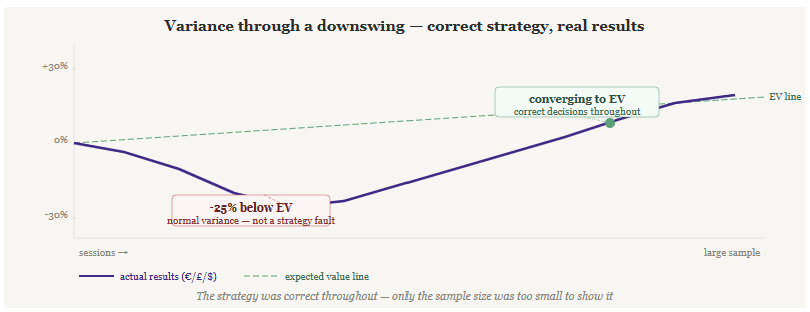
This reframe has significant practical consequences.
Professionals don’t change strategy during downswings. When a professional is losing, they ask: “Am I making the correct decisions?” If yes, they continue. They don’t reduce aggression, play more conservatively, or deviate toward “safer” strategies that feel better during a cold run. Those deviations reduce EV.
Professionals don’t increase stakes to recover losses. Chasing is the recreational response to variance. It increases exposure precisely when the bankroll can least afford it. The professional response is to maintain or reduce stakes based on bankroll, not to accelerate stakes based on frustration.
Professionals don’t get euphoric during winning runs. Running hot is the symmetrical problem to running cold. A professional who has won 15 consecutive sessions hasn’t necessarily improved. They may just be experiencing positive variance. Increasing stakes based on a winning run — before confirming the bankroll genuinely supports the new level — is as much a variance error as chasing losses.
Understanding Variance Quantitatively
The discomfort of variance is proportional to how poorly its scale is understood.A poker player winning 5 big blinds per 100 hands — a solid, sustainable win rate — faces a standard deviation of roughly 100 big blinds per 100 hands. Over a 10,000-hand sample, they might be 3–4 standard deviations below expectation through normal variance. At 50NL (£0.25/£0.50), that represents a loss of several hundred pounds while playing correctly.
Understanding this quantitatively — knowing that extended bad runs are mathematically expected, not anomalous — is what allows professionals to maintain correct decision-making through them. Players who don’t understand variance’s scale interpret downswings as evidence of a problem, change strategy, and compound the issue.
Framework 5: Records Over Feelings
Ask a recreational player how they’ve performed over the last three months. They’ll give you an impression: “Pretty well” or “Not great, but I had a few good sessions.” Ask a professional the same question. They’ll give you a number.
Professionals track everything. Session by session, bet by bet: the stake, the odds, the result, the closing line (in sports betting), the EV of key decisions (in poker). Not because they’re obsessive — because without data, decision quality cannot be evaluated honestly.
Memory distorts gambling results systematically. Wins are more salient than losses. Good decisions that lost are forgotten faster than bad decisions that won. The human brain is a poor accounting system for anything with high variance and emotional charge.
The only honest feedback mechanism is records. They’re the difference between making decisions based on accurate information about your own performance and making decisions based on a flattering or distorted impression of it.
What to Track by Game
Poker: Session date, game type, stakes, hours played, result in big blinds and currency, cumulative result. Ideally, key hand histories for review. Software like PokerTracker or Hold’em Manager automates online tracking and provides win rate, standard deviation, and percentile performance data.
Sports betting: Every bet logged with date, market, odds taken, stake, result, and closing odds. The closing odds are essential — they allow closing line value (CLV) calculation, which is a better indicator of genuine edge than results alone over short samples.
Casino games: Session date, game, stakes, hands played (approximate), result. Less granular than poker tracking but sufficient to identify whether your basic strategy is being applied correctly and what your actual results look like over volume.
The target is enough data to be statistically meaningful. For sports betting, 500+ bets before drawing conclusions about ROI. For poker, tens of thousands of hands before win rates stabilise.
Framework 6: Game Selection Is Itself a Skill
Where you play matters as much as how you play. Professionals spend significant time and thought on game selection — choosing the stakes, format, opponent pool, and game type that maximises their edge. This is a form of skill that recreational players rarely apply and almost never optimise.
In Poker
A professional poker player doesn’t just sit at the nearest available table. They evaluate:
- Opponent quality: Are there weaker players in this game? How weak? What’s the expected hourly edge against this field?
- Table dynamics: Is the game running loose and aggressive? Tight and passive? What style exploits the specific tendencies present?
- Stake appropriateness: Is this stake level supported by my bankroll? Am I the strongest player at the table, or is someone significantly better than me present?
Moving away from a game where a very strong player has arrived — even mid-session — is not weakness. It’s intelligent game selection. A professional’s goal is edge maximisation, not ego preservation.
In Sports Betting
Professional sports bettors select their markets as carefully as their bets within those markets:
- Market efficiency: Major league match result markets are highly efficient — sustained edge is rare. Lower-league markets, certain proposition markets, and early-season lines offer more opportunity.
- Operator selection: Sharp books (Pinnacle) and betting exchanges (Betfair) accept winning bettors. Soft books offer better initial prices but limit identified winners aggressively.
- Sport and league specialisation: Deep knowledge of a specific competition outperforms shallow knowledge across many. Professionals typically specialise.
In Casino Games
The house edge varies dramatically by game and by variant. A professional approach to casino gambling means choosing the lowest-edge available game in its best available form — 3:2 blackjack over 6:5, European roulette over American, full-pay video poker variants over reduced-pay ones.
Game selection produces edge before a single decision is made.
Framework 7: Emotional Discipline as a Technical Skill
Professional gambling literature often treats emotional control as a personality trait — something you either have or develop gradually through temperament. Professionals approach it differently: as a technical skill with specific techniques and failure modes.
The primary failure modes are well-documented:
Tilt (negative emotional state following bad results): produces overaggression, loose calls, and abandonment of correct strategy. The professional response is to identify the emotional state as quickly as possible — often before it degrades decisions — and to either take a break or apply explicit decision checks.
Overconfidence (positive emotional state during good runs): produces looser standards of analysis, reduced attention to opponent reads, and stake increases that aren’t justified by bankroll. The professional response is to treat winning runs with the same analytical scepticism as losing runs.
Boredom (flat emotional state during slow sessions): produces action-seeking behaviour — calling more hands, placing more bets — to increase stimulation. The professional response is to recognise boredom as a trigger for poor decisions and to set session limits that prevent it from accumulating.
The technical approach to emotional management:
- Pre-session preparation: Define in advance the conditions under which you’ll end the session. A specific loss limit, a time limit, or a specific number of orbits. Decisions made in advance are less susceptible to emotional distortion than decisions made in the moment.
- In-session check-ins: Brief periodic assessment — “Am I making decisions based on the current situation, or based on how the session is going?” — creates a moment of separation between emotional state and decision.
- Post-session review: Evaluate decisions independently of results. Were the key decisions I made today correct? This reinforces the decision/result separation at the meta level.
Framework 8: Bankroll as a Tool, Not a Score
Recreational players often treat their bankroll as a scorecard — the number that measures how well they’re doing. It feels good when it goes up. It feels bad when it goes down. Decisions are influenced by where it currently sits.
Professionals treat their bankroll as a working tool — the resource that enables them to make decisions at the appropriate scale for their edge. Its current level determines what stakes are appropriate. Nothing else.
When a professional’s bankroll management rules indicate moving down in stakes, they move down. When they indicate staying put through a downswing, they stay put. When they indicate moving up after sustained growth, they move up. The bankroll is not a measure of pride — it’s a parameter in a decision function.
This separation prevents two of the most costly patterns in recreational gambling:
Playing above bankroll: risking too large a proportion of total funds per decision, which increases risk of ruin even for skilled players. The bankroll can’t sustain normal variance at those stakes.
Playing below potential: being too conservative with stake sizing relative to edge and bankroll, which reduces long-run growth rate unnecessarily.
The professional relationship with bankroll is purely functional. It’s a number that determines appropriate stake sizing — nothing more.
Framework 9: Continuous Learning as a Competitive Requirement
In most gambling environments, the competition evolves. Poker strategy has changed dramatically over the past decade as GTO frameworks became widely understood. Sports betting markets have become more efficient as analytical tools improved and professional syndicates became more sophisticated. The games themselves shift.
Professionals treat their edge as something that requires active maintenance, not a static advantage they can rely on indefinitely.
A poker player whose strategy hasn’t developed since 2015 is operating on outdated frameworks against opponents who have adapted. A sports bettor whose models haven’t incorporated new data sources or methodologies is likely being priced out of markets by bettors who have.
The implication is a continuous investment in study:
- Hand history review and solver work (poker)
- Model validation and market analysis (sports betting)
- Game condition monitoring — rule changes, deck composition, shuffle frequency (blackjack)
- Understanding how your specific opponent pool is evolving
This isn’t optional for professional-level results. The moment a player stops developing, they begin to erode — not because they’ve gotten worse, but because their competition has gotten better.
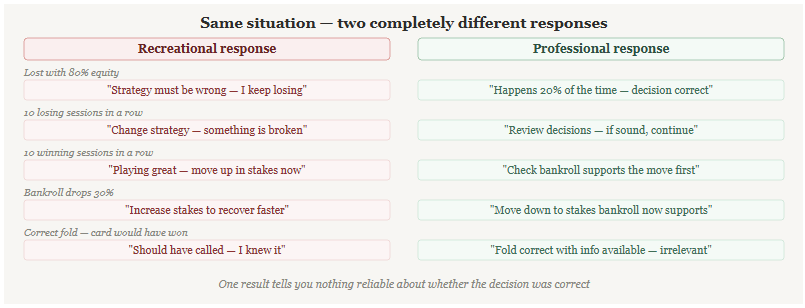
The Mindset Gap: A Direct Comparison
| Situation | Recreational Response | Professional Response |
|---|---|---|
| Lose a hand with 80% equity | “Terrible beat — strategy must be wrong” | “Expected to happen 20% of the time — decision was correct” |
| Win 10 sessions in a row | “I’m playing great — move up in stakes” | “Check bankroll supports the move — may be variance” |
| Lose 10 sessions in a row | “Change strategy immediately” | “Review decisions for errors — if sound, continue” |
| Make a correct fold that would have won | “Should have called — I knew it” | “Fold was correct given information available — result irrelevant” |
| Face a recurring difficult decision | “Trust my gut” | “Review records — what does data say about this spot?” |
| Bankroll drops 30% | “Increase stakes to recover faster” | “Move down to stakes bankroll now supports” |
| Running hot — feel invincible | “Back bigger, press the edge” | “Variance is positive — maintain sizing rules” |
| Opponent makes an exploitable mistake | “They got lucky — ignore it” | “Adjust strategy to exploit the pattern” |
Expert Insight: What Separates the Very Best
The frameworks above separate professional from recreational thinking. Within the professional tier, there’s a further distinction — between players who sustain modest long-run profitability and those who achieve exceptional results.
The differences at that level are more subtle:
Continuous opponent modelling. Exceptional players don’t just apply a general framework — they build specific models of specific opponents over time. They know that a particular player always over-folds to three-bets in certain positions, or that a particular sportsbook consistently underestimates home advantage in a specific league. That specificity adds edge that generic frameworks don’t generate.
Higher tolerance for short-run pain. The best poker players in the world have experienced downswings that would break most people. The discipline to continue making correct decisions through 200-buy-in downswings, while maintaining the analytical clarity to distinguish genuine strategic errors from variance, is extraordinary — and rare.
Honest self-assessment without ego protection. Recreational players often know they’re making mistakes but don’t examine them honestly because doing so would conflict with their self-image as a capable player. The very best are ruthlessly self-critical — not in a self-destructive way, but in the sense of subjecting their own decisions to the same scrutiny they’d apply to an opponent’s.
Edge maintenance. The very best are never satisfied with their current level. They’re looking for what the next refinement is, where the current version of their model or strategy is leaving EV on the table, which patterns in their decision-making are costing them units they could recover.
“The gap between good and exceptional isn’t knowledge. It’s the honesty to see your own decisions as clearly as you see everyone else’s — and the discipline to fix what you find.”
Pros and Cons: Adopting a Professional Mindset
| Benefit | Challenge |
|---|---|
| Decisions improve independently of short-run results | Requires genuinely accepting losing runs without strategy changes |
| Performance becomes measurable through data | Demands consistent record-keeping discipline |
| Variance becomes less distressing — it’s expected, not anomalous | Takes significant time to accumulate the sample sizes that make data meaningful |
| Bankroll stays protected through correct sizing | Moving down in stakes feels like failure even when it’s the right decision |
| Continuous improvement becomes possible through honest review | Honest self-assessment is uncomfortable — most people resist it |
| Edge compounds over time through disciplined application | The rewards are long-run and slow — patience is genuinely hard |
Applying These Frameworks as a Recreational Player
You don’t need to be a professional to benefit from professional thinking. Even recreational players who gamble primarily for entertainment produce better decisions — and lose less money — when they apply these frameworks.
The accessible entry points:
Start with the decision/result separation. After every significant gambling decision, evaluate the decision on its merits before looking at the result. Was it the correct choice given available information? Train yourself to ask this question habitually.
Learn basic strategy before playing blackjack. This is the single most direct application of EV thinking available to a casino player — a complete decision framework that takes a few hours to learn and immediately improves every hand.
Track your results, even roughly. Even a simple session log — date, game, result — provides more honest feedback than memory over any meaningful time period.
Define your session limits before you sit down. A loss limit and a time limit, decided in advance, remove the need to make willpower decisions in emotionally charged moments.
Understand variance before interpreting results. A month of losing sessions doesn’t mean your strategy is wrong. A month of winning sessions doesn’t mean it’s right. The sample is too small in both cases. This knowledge alone prevents a huge number of unnecessary strategy revisions.
Responsible Gambling
Professional gambling frameworks are analytical tools. They are not a pathway to guaranteed profit, and they are not a protection against the psychological risks gambling can carry for some people.
Even professional gamblers with genuine, documented edge lose money in specific periods. Variance is real, and the psychological difficulty of sustained downswings is genuine — even when decisions are correct and the overall approach is sound. The frameworks in this guide are designed for people who approach gambling as an analytical discipline. They are not designed for people experiencing a problematic relationship with gambling.
If gambling is generating financial stress, affecting relationships, or feeling compulsory rather than recreational, the right response is not better EV thinking. The right response is to use the tools that all regulated gambling providers offer: deposit limits, session limits, time-outs, and self-exclusion. These tools are free, immediate, and effective.
FAQ
What is the main difference between professional and recreational gamblers?
The most fundamental difference is how they evaluate decisions. Recreational gamblers judge decisions by their outcomes — a decision was good if it won, bad if it lost. Professional gamblers judge decisions by their expected value at the moment they were made, independently of what followed. This distinction produces systematically different decision quality and systematically different long-run results.
Do professional gamblers always win?
No. Professional gamblers lose regularly — individual hands, sessions, weeks, and sometimes months. The difference is that their losses are within the expected range of variance for their game and stake level, and their decisions remain correct throughout. Long-run profitability comes from the accumulated EV of thousands of correct decisions, not from winning at any particular rate in any particular period.
What is tilt and how do professionals manage it?
Tilt is the deterioration of decision quality following negative emotional responses to bad outcomes. It’s one of the most costly phenomena in gambling and affects players at all skill levels. Professionals manage tilt through pre-session preparation (defining in advance when to stop), in-session monitoring (brief checks on whether decisions are being made based on the current situation or on emotional state), and post-session review (evaluating decisions independently of results). Tilt management is treated as a technical skill, not a personality trait.
How do professional gamblers use expected value?
Every significant decision is evaluated by its expected value — the average outcome across a large number of identical decisions. Before acting, professionals assess: what’s the probability of each outcome? What’s the value of each outcome? Does the weighted average produce a positive or negative number? If positive, the action is taken. If negative, it’s declined. The result of any single instance is irrelevant to whether the decision was correct.
Can recreational players develop a professional mindset?
Yes — and the most accessible frameworks are genuinely learnable. The decision/result separation, basic EV thinking, variance tolerance, and pre-session limits produce better decisions for any player at any level. The more demanding frameworks — systematic opponent modelling, continuous learning, deep record-keeping — require more investment but produce proportional improvements for anyone willing to apply them consistently.
Why do professional gamblers keep such detailed records?
Because memory distorts gambling results systematically. Wins are more memorable than losses. Good decisions that lost are forgotten faster than bad decisions that won. Without accurate records, it’s impossible to distinguish genuine positive edge from a fortunate variance run, or to identify specific decision patterns that are costing money. Records are the only honest feedback mechanism available — they allow decisions to be evaluated on their merits over sufficient sample sizes to be statistically meaningful.
Is it possible to think like a professional without gambling professionally?
Yes. The frameworks in this guide — EV thinking, decision/result separation, variance understanding, bankroll discipline — improve gambling decisions at any level and scale. They also happen to be useful mental frameworks outside of gambling entirely: in investing, in business decisions, and in any domain where good processes produce better long-run outcomes than results-based revision. The discipline is the point, not the professional status.
Conclusion
The gap between professional and recreational gambling thinking is not primarily a knowledge gap. It’s a framework gap.
Professionals ask different questions than recreational players. They track different things. They respond differently to variance. They evaluate their decisions by different criteria. They treat their bankroll, their game selection, and their emotional state as technical variables to be managed — not as background conditions to be accepted or complained about.
None of this is easy. All of it is learnable.
The most powerful entry point is the simplest: start evaluating decisions by whether they were correct, not by whether they won. That single shift — consistently applied, honestly maintained — changes the trajectory of decision quality over time more than any specific strategy improvement.
The result isn’t guaranteed profit. No framework guarantees that. What it produces is something more durable: decisions you can defend on their merits, a relationship with variance that doesn’t distort your judgment, and an honest picture of whether your approach is actually working.
That clarity, over time, is what separates the gamblers who improve from the ones who perpetually start over.
Related Reading
- What Is Expected Value in Gambling?
- Bankroll Management: Protecting Your Money Over the Long Run
- Skill vs Luck in Gambling: Where the Line Actually Falls
- Value Betting in Sports: Finding Edge Against the Market
- Can Skill Overcome the House Edge?
External Sources:
- NIH/PubMed — The Gambler’s Fallacy and Decision Making Under Uncertainty
- University of Chicago — A Probabilistic View on the Economics of Gambling
No gambling strategy guarantees profit. All gambling carries financial risk. Past performance does not predict future results. If you have concerns about your gambling, please use the responsible gambling tools available through your provider or contact your local support service.