
Reading time: ~30 minutes | Last updated: June 2026
Quick Answer: Online Poker is the most skill-based gambling game available. Unlike casino games where the house holds a permanent mathematical edge, poker pits players against each other — the casino takes only a fixed rake. Over large enough samples, skilled players win consistently and predictably. The evidence is unambiguous: at the 2010 World Series of Poker, players identified as highly skilled beforehand achieved an average return on investment of +30%, compared to −15% for all others. That gap doesn’t happen by chance. This guide covers every skill dimension that produces it — from position and pot odds to GTO strategy, bankroll management, and the mental game.
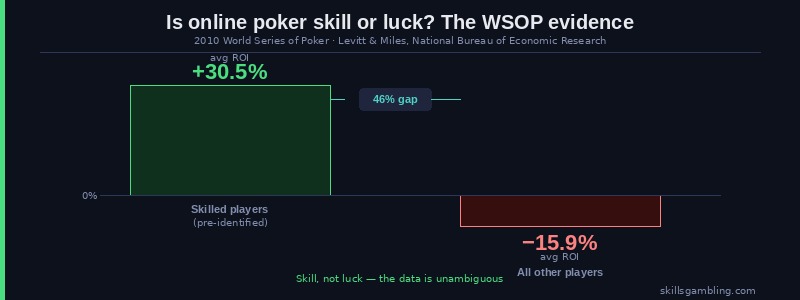
Table of Contents
- Is Poker Skill or Luck? The Evidence
- How Poker Actually Works: The Structural Advantage
- The Poker Skills That Determine Long-Term Results
- Position: The Most Undervalued Skill in Poker
- Starting Hand Selection: Playing Fewer Hands Better
- Pot Odds and Expected Value: The Mathematics of Every Decision
- Aggression: Why Betting and Raising Win More Than Calling
- Reading Opponents: Exploitative vs GTO Play
- Bluffing: The Art and Mathematics of Deception
- Bankroll Management for Poker Players
- The Mental Game: Variance, Tilt, and Long-Term Thinking
- Online Poker vs Live Poker: Key Differences
- Texas Hold’em vs Other Poker Variants
- Common Poker Mistakes That Cost Money
- How to Improve at Poker: A Structured Approach
- Responsible Gambling
- FAQ
- Conclusion
Is Poker Skill or Luck? The Evidence
The question of whether poker is primarily skill or luck isn’t philosophical — it’s empirical. And the data gives a clear answer.
In a landmark study published by the National Bureau of Economic Research, economists Steven Levitt and Thomas Miles analysed performance at the 2010 World Series of Poker. Players identified as highly skilled before the tournament began — based on 2009 results and published rankings — achieved an average return on investment of +30.5%. All other players averaged −15.9%. That 46-percentage-point gap is statistically impossible to attribute to chance across a sample of that size.
The test is even simpler than a study. Ask: can a player intentionally lose at poker? In roulette or slots, no — randomness means you might win regardless of intent. In poker, yes — fold every hand preflop and you are guaranteed to lose your blinds every orbit. Your decisions have direct, measurable consequences on your results. That’s the definition of a skill game.
“In the short term, the cards you’re dealt determine who wins any given hand. In the long term, the decisions you make determine everything.”
Where luck genuinely exists in poker:
- Which cards you receive is random
- Which community cards fall is random
- A weaker player beats a stronger player in any individual hand regularly
- Even elite players experience significant losing stretches over thousands of hands
Where skill dominates over time:
- Preflop hand selection and position awareness
- Post-flop decision making — betting, calling, raising, folding
- Reading opponents and identifying exploitable tendencies
- Bankroll management and game selection
- Emotional discipline under variance pressure
The crossover point — where skill reliably becomes the dominant factor in cumulative results — has been estimated at approximately 1,500 hands for cash games. Below that threshold, variance makes results unreliable as a measure of ability. Above it, the skill signal becomes increasingly clear. This is why serious poker players track results over tens of thousands of hands, not over sessions.
How Poker Actually Works: The Structural Advantage
Understanding poker’s structure explains why skill can produce a genuine, sustained player edge — something impossible in house-banked casino games.
In casino games like roulette or blackjack, the house holds a permanent mathematical edge built into the rules. No amount of skill eliminates it entirely. The best a player can do is minimise the edge through optimal play.
In poker, the casino takes a rake — a fixed percentage or fee from each pot, typically 3–5% up to a cap. The casino profits the same amount regardless of who wins. Your opponents are other players, not the house. If you make better decisions than your opponents consistently, you profit from their mistakes over time.
This creates a zero-sum competition where skill determines outcomes. The rake is the cost of playing — think of it as the table fee. Managing that cost (through rakeback deals, game selection, and volume) is itself a skill.
Texas Hold’em: The Standard Game
The most widely played poker variant. Each player receives two private cards (hole cards). Five community cards are dealt in three stages — the flop (three cards), the turn (one card), and the river (one card). Players form the best possible five-card hand from any combination of their hole cards and the community cards.
Betting occurs before the flop (preflop), after the flop, after the turn, and after the river. Each street presents decisions: check, bet, call, raise, or fold. These decisions — hundreds per session — are where skill accumulates or erodes.
The Hand Rankings
| Hand | Example | Frequency |
|---|---|---|
| Royal Flush | A♠ K♠ Q♠ J♠ 10♠ | Extremely rare |
| Straight Flush | 9♣ 8♣ 7♣ 6♣ 5♣ | Rare |
| Four of a Kind | K♦ K♣ K♥ K♠ Q | Rare |
| Full House | J♠ J♦ J♣ 8♥ 8♠ | Uncommon |
| Flush | A♥ J♥ 8♥ 5♥ 2♥ | Uncommon |
| Straight | 10♦ 9♣ 8♥ 7♠ 6♦ | Moderate |
| Three of a Kind | 7♠ 7♥ 7♦ K♣ 4♠ | Moderate |
| Two Pair | A♠ A♣ 5♥ 5♦ Q | Common |
| One Pair | Q♦ Q♠ 9♣ 6♥ 2♠ | Very common |
| High Card | A♣ J♦ 8♥ 5♠ 2♣ | Very common |
The Poker Skills That Determine Long-Term Results
Poker skill is not monolithic. It’s a collection of distinct competencies that compound across hundreds of thousands of decisions. The best players are strong across all of them. Beginners typically have critical gaps in two or three.
The core skill stack:
- Position awareness — understanding and exploiting the informational advantage of acting after your opponents
- Hand selection — knowing which hands to play from which positions, and folding the rest
- Mathematical foundations — pot odds, implied odds, equity calculations
- Aggression — understanding why betting and raising generate more profit than passive play
- Reading opponents — identifying tendencies, leaks, and exploitable patterns
- Bluffing construction — building credible, balanced bluffing ranges
- Bankroll management — surviving variance to reach the long run
- Mental game — playing consistently regardless of recent results
Each of these is addressed in its own section below. The key point here is that improvement at poker is not about discovering secrets — it’s about systematic reduction of errors across these dimensions.
“Every chip you didn’t lose to a mistake is a chip you won. Most poker profit comes not from brilliant plays but from consistently making fewer errors than your opponents.”
Position: The Most Undervalued Skill in Poker
Position is the single most impactful structural advantage in poker, and it costs nothing to exploit — it simply requires knowing how to use it.
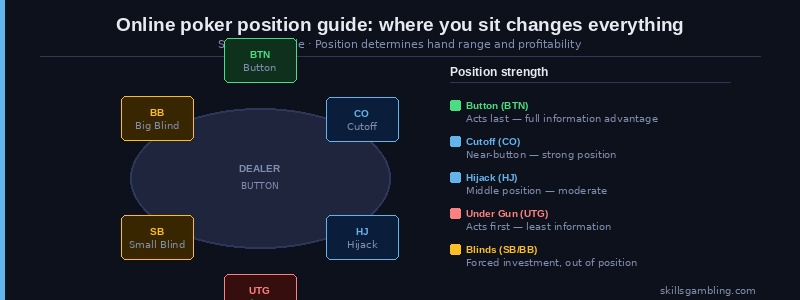
Position refers to where you sit relative to the dealer button, which determines the order of betting. Players who act last on each street — particularly the button (dealer position) — have a profound informational advantage: they see every opponent’s action before making their own decision.
Why Position Is So Powerful
When you act last post-flop, you have access to information your opponents don’t:
- Did they check? They may be weak, or they may be trapping.
- Did they bet? You know the size before committing.
- Did they fold? You can take the pot uncontested.
This information allows you to make more accurate decisions, extract more value from strong hands, bluff more profitably, and control pot size more precisely.
Position is so valuable that hands played in position win significantly more money than the same hands played out of position — even when the cards are identical.
Positions at a Six-Player Table
| Position | Name | Notes |
|---|---|---|
| 1st to act post-flop | UTG (Under the Gun) | Weakest — act first with no information |
| 2nd | UTG+1 / MP | Weak — limited information |
| 3rd | Hijack | Moderate — beginning to gain advantage |
| 4th | Cutoff | Strong — near-button position |
| 5th | Button | Strongest — acts last on every post-flop street |
| Blinds | SB / BB | Worst — forced to invest before seeing action |
How to Use Position
From early position: play tighter. You have more opponents to act after you with no information about their hands. Premium hands (AA, KK, QQ, AK) play well from anywhere. Speculative hands like small pairs and suited connectors become much more problematic.
From late position: widen your range. The informational advantage compensates for weaker starting cards. Hands that are marginal from UTG become profitable from the button.
The button is the most profitable seat at any poker table, every time. Skilled players exploit it by playing more hands, making more steals, and applying more post-flop pressure than their position-unaware opponents recognise.
Starting Hand Selection: Playing Fewer Hands Better
The most common and costly mistake in poker is playing too many hands. It seems counterintuitive — surely more hands means more opportunities? In practice, playing weak hands from bad positions is a direct transfer of money to better-positioned opponents.
The Fundamental Principle
Your starting hand determines your hand’s potential, not its destiny. But playing hands with poor potential from poor positions creates recurring situations where you’re behind and facing difficult decisions with weak cards and no informational advantage.
A profitable preflop strategy is simple: play strong hands, play them aggressively, and fold marginal hands in bad positions without regret.
Hand Strength Categories
Premium hands (play from any position): AA, KK, QQ, AK suited — these are consistently strong across all board textures and positions.
Strong hands (play from most positions, including middle position): JJ, TT, AK offsuit, AQ suited, KQ suited — strong but require more care post-flop.
Playable hands (prefer late position): 99, 88, 77, AJ, AT, KJ, suited connectors (87s, 76s, 65s) — position-dependent. These hands profit most when you act last and can control pot size.
Speculative hands (button and cutoff only): Small pairs (22–66), weaker suited connectors, suited aces — need specific post-flop conditions to be profitable. Play them when position compensates for hand weakness.
Fold the rest. The hands not on this list — offsuit weak aces, low unconnected cards, weak kickers — are money losers in most situations. Folding them is not weakness; it’s the correct mathematical decision.
The Fold is a Weapon
Recreational players fold reluctantly, treating every fold as a loss. Skilled players understand that a well-timed fold saves money. In a game where decisions are made hundreds of times per session, consistent preflop discipline compounds into a significant edge over players who can’t let go of weak hands.
Pot Odds and Expected Value: The Mathematics of Every Decision
Every call in poker is a mathematical decision. Whether you’re drawing to a flush on the turn or deciding whether to call a river bet, the correct answer is calculable — and understanding expected value in gambling decisions is the foundation that makes those calculations meaningful.
Pot Odds
Pot odds are the ratio of the current pot size to the cost of calling. They tell you what return you need on your call to break even.
Example: The pot is £100. Your opponent bets £50. You must call £50 to win £150 (the pot plus the bet).
Pot odds = 150:50 = 3:1
To profitably call, your hand needs to win more than 1 in 4 times (25%). If it wins more often than that, the call has positive expected value.
Equity
Equity is your probability of winning the hand if it goes to showdown, expressed as a percentage.
If you have a flush draw on the flop, you have approximately 9 outs — nine remaining cards that complete your flush. With two cards to come:
Equity ≈ 9 × 4 = 36% (the rule of 4 — multiply outs by 4 on the flop)
With one card to come (the turn):
Equity ≈ 9 × 2 = 18% (the rule of 2)
Combining Pot Odds and Equity
If your equity (36%) exceeds the percentage required to call (25% in the example above), calling is profitable. If your equity is lower, folding is correct.
This calculation doesn’t require perfect precision at the table — approximate equity estimates are sufficient for most decisions. The skill is developing the habit of asking the question before calling, rather than calling based on hope or attachment to the hand.
Implied Odds
Implied odds extend pot odds to account for future betting. If completing your draw will likely extract further bets from your opponent, you can profitably call even when the current pot odds don’t mathematically justify it.
Example: calling a small bet with a set draw (low pair hoping to hit three of a kind) has poor direct pot odds but excellent implied odds — because when you hit, you’re often looking at winning a large pot from a surprised opponent holding an overpair.
Aggression: Why Betting and Raising Win More Than Calling
Passive poker — calling frequently, checking when you could bet, reluctance to raise — is a reliable way to lose money steadily. Controlled aggression is one of the most consistent markers that separates winning players from losing ones.
Why Aggression Wins
Aggressive play creates two ways to win: your opponent folds (you take the pot immediately) or you have the best hand at showdown. Passive play creates one way to win: having the best hand at showdown.
Every bet and raise puts your opponent to a decision under pressure. Calling is the weakest response — it wins only when you have the best hand, which you can’t always be sure of.
Practical aggression principles:
Bet for value relentlessly. When you have a strong hand, bet it. Don’t slow-play — charge opponents to chase their draws and miss out on value from worse hands that would call your bets.
Use continuation bets (c-bets) consistently. If you raised preflop, you showed strength. Following up with a bet on the flop — regardless of whether you improved — wins pots immediately a large percentage of the time. Opponents who missed the flop (which happens roughly two-thirds of the time) will often fold to a single bet.
Three-bet (re-raise) profitably. Three-betting forces opponents to commit more chips with a weaker range, or fold hands that had reasonable equity. It’s one of the highest-leverage moves available preflop.
Selective, purposeful aggression — not reckless betting — is what separates profitable players from recreational ones.
Reading Opponents: Exploitative vs GTO Play
Modern poker strategy operates on a spectrum between two approaches: GTO (Game Theory Optimal) and exploitative play. Understanding both — and knowing when to use each — is a genuine differentiating skill.
GTO Play
Game Theory Optimal is a mathematically balanced approach derived from game theory. A perfect GTO player makes every opponent theoretically indifferent between their options — calling, folding, or raising yields the same expected value. The result: a GTO player cannot be exploited.
GTO achieves this through:
- Mixed frequencies: checking and betting strong hands at set ratios, making your range unpredictable
- Balanced ranges: distributing value hands and bluffs across betting actions in fixed proportions
- Indifference principle: sizing bets so opponents theoretically break even on calls
The limitation of GTO: it ignores exploitable opponents. Against a player who folds 80% of the time to continuation bets, a pure GTO strategy leaves money on the table. GTO doesn’t punish mistakes; it prevents exploitation.
Exploitative Play
Exploitative play identifies opponent tendencies and deviates from GTO to maximise profit against those specific weaknesses.
Common exploitable tendencies:
- Calling too often (calling station): increase value bet frequency, reduce bluffing
- Folding too often: increase bluff frequency, especially on dry boards
- Over-betting draws: charge them more when you have strong made hands
- Never bluffing: their bets mean strength; fold more, call less in large spots
- Always c-betting: float (call) more on the flop and take pots away on later streets
The risk of exploitative play: you become exploitable yourself if your opponent recognises and adjusts to your deviation. A player who bluffs 80% of the time because someone is over-folding becomes extremely vulnerable if that opponent adapts.
The Practical Balance
For most players in most games:
Use GTO principles as your foundation to avoid being exploited. Make exploitative adjustments against opponents with clear, readable tendencies.
At lower stakes online and in live games, most players have obvious leaks. Exploiting them directly is more profitable than adhering rigidly to GTO. As stakes increase and opponents improve, GTO adherence becomes more important because the deviations of opponents become smaller and harder to identify.
Bluffing: The Art and Mathematics of Deception
Bluffing is one of poker’s most discussed concepts and one of its most misunderstood. Good bluffing is not about nerve or personality — it’s about mathematics, timing, and constructing believable stories.
Why Bluffing Is Necessary
Without bluffing, your betting range becomes trivially exploitable. If you only bet when you have strong hands, observant opponents fold every time you bet unless they have premium holdings. Your value bets stop getting called. Your profits collapse.
Balanced bluffing makes your betting range unpredictable. When opponents can’t distinguish your value bets from your bluffs, they’re forced to call with a wider range — which is exactly what you want when you’re value betting.
The Mathematics of a Good Bluff
A profitable bluff doesn’t need to work every time. It needs to work often enough to show positive expected value.
Example: You bluff £100 into a £100 pot on the river. If your bluff succeeds, you win £100. If it fails, you lose £100.
For this bluff to break even, it must succeed at least 50% of the time.
If your opponent folds more than 50% of the time to this bet, the bluff is immediately profitable regardless of your cards. If they fold less than 50%, the bluff loses money and you shouldn’t make it.
Bluffing Principles
Choose the right boards. Bluff on boards where your range is credibly strong and your opponent’s range is credibly weak. Bluffing into calling stations on wet boards is expensive.
Tell a coherent story. Your bluffing range should make sense given your preflop action, position, and the community cards. A bluff that doesn’t fit the narrative your previous actions tell will be called more often.
Bluff with equity when possible. Semi-bluffs — bets made with hands that have drawing potential — are more profitable than pure bluffs. If called, you still have outs to improve.
Don’t over-bluff. Bluffing too frequently is as costly as never bluffing. Both are exploitable — one by folding, one by calling.
Bankroll Management for Poker Players
No skill at the poker table matters if you go broke during a downswing before your edge materialises. Bankroll management is the structural skill that keeps you in the game long enough for the mathematics to work in your favour.
Poker variance is large. Even a genuinely skilled, winning player can lose for hundreds of hours. A 30 buy-in downswing at your regular stake is not rare — it’s a mathematical expectation for players who play sufficient volume. How professional gamblers approach long-term stake management applies directly to poker’s variance challenge.
Cash Game Bankroll Requirements
| Player Type | Buy-ins Required |
|---|---|
| Recreational (loss acceptable) | 10–20 buy-ins |
| Serious (moving up when ready) | 20–30 buy-ins |
| Professional (income dependent) | 40–50+ buy-ins |
Example: Playing £0.25/£0.50 No-Limit Hold’em (£50 buy-in), a serious player should have £1,000–£1,500 dedicated to that stake before sitting down. Not their total savings — their dedicated poker bankroll.
Tournament Bankroll Requirements
Tournaments have far higher variance than cash games. A single tournament is decided significantly by luck even for elite players. Professional tournament players typically maintain 100–200 buy-ins for their primary tournament level.
Moving Up and Down Stakes
Move up when you have 30+ buy-ins for the next stake level and have demonstrated consistent positive results at your current level over a meaningful sample.
Move down when your bankroll drops below 20 buy-ins for your current stake. This is not failure — it’s the discipline that separates players who survive variance from those who go broke.
The discipline to drop down is one of the hardest skills in poker psychology. Most players resist it because it feels like admitting defeat. Winning players treat it as protecting their ability to play.
The Mental Game: Variance, Tilt, and Long-Term Thinking
Poker is unique among skill-based activities in that you can make perfect decisions and still lose, repeatedly, for extended periods. The psychological challenge this creates — maintaining process-focused decision-making while results contradict your expectations — is what most players underestimate most severely.
Variance and Sample Sizes
Variance is the natural swing in results around expected value. In poker, variance is large enough that results over hundreds of hours carry significant noise. A player running at +5 big blinds per 100 hands over 10,000 hands might be a genuine winner — or might have run well. A player who lost over the same sample might be a genuinely losing player — or might have run badly.
Sample thinking is the most important mental skill in poker: evaluate decisions by their quality, not their outcomes.
A call that was correct given the information available at the time remains correct even if the opponent happened to have the one hand that beats you. A bad call that happened to work out was still a bad call. Evaluating decision quality independently of results is what allows you to actually improve rather than chasing what worked recently.
Tilt
Tilt is the deterioration of decision-making quality caused by emotional response to results — typically losing, though winning can cause its own form of tilt (overconfidence, reckless play).
Recognising tilt in yourself is harder than it sounds. The common markers:
- Making calls you wouldn’t normally make to “get even”
- Increasing bet sizes beyond your plan
- Playing in a way designed to punish a specific opponent
- Feeling that the game “owes you” after a bad run
- Losing track of pot sizes or opponent tendencies
The correct response to tilt: stop playing. Log off. Come back when the emotional reaction has passed and you can evaluate decisions clearly. There is no discipline more valuable in poker than the ability to stand up from a losing session without chasing.
Process Over Results
The mental framework that sustains long-term winning players is simple but difficult to maintain: judge yourself by your decisions, not your results.
This means reviewing hands you lost to check if you played correctly, not just reviewing bad beats. It means acknowledging that a good player with bad luck and a bad player with good luck can look identical over short samples. It means being willing to build bankroll management habits that protect you from the emotional volatility of variance.
Online Poker vs Live Poker: Key Differences
The game is the same. The environment and skill demands differ substantially.
Volume and Speed
Online poker allows 6–12 tables simultaneously with hands dealt at 60–80 per hour per table. A serious online player can accumulate 50,000+ hands per month. Live poker produces approximately 25–30 hands per hour at a single table.
This means online poker accelerates skill development — the sample sizes required to assess your true win rate are achievable in months online versus years live.
Reads and Tells
Live poker provides physical information unavailable online: betting timing, physical tells, speech play, stack handling, and demeanour. Experienced live players extract significant edge from this information layer. Reading opponents is a distinct skill set in live poker.
Online poker provides digital information unavailable live: HUD stats (hands per hour, VPIP, PFR, aggression frequency across thousands of hands), timing tells, and bet-sizing patterns. Tracking software gives online players population-level reads on opponents that no live player could accumulate.
Game Selection
Online: access to thousands of tables across multiple stakes simultaneously. Finding soft games — tables with weak players — requires knowing which stakes and times attract recreational players.
Live: limited to games running at your local cardroom or casino. Game selection is less flexible but soft games at live casinos remain extremely common because most recreational players are not improving their game systematically.
Rake
Online rake typically ranges from 3–5% with a cap, plus time charges at some sites. Live rake is usually 5–10% with a higher cap. The higher live rake means live players need a larger edge over opponents to profit net of rake.
Texas Hold’em vs Other Poker Variants
Texas Hold’em dominates online and live poker in 2026. But other variants offer distinct skill challenges — and sometimes softer player pools.
Pot-Limit Omaha (PLO)
Each player receives four hole cards and must use exactly two of them with three community cards. The requirement to use exactly two hole cards creates dramatically different hand values compared to Hold’em — flushes and full houses are far more common, making hand reading more complex.
PLO has significantly higher variance than Hold’em. Even strong equity advantages (60/40) in PLO are razor-thin compared to Hold’em. Bankroll requirements at the same stakes should be roughly doubled.
The skill edge in PLO: most PLO players come from Hold’em and underestimate how much the four-card game changes hand values and draw equities. Players who study PLO specifically often hold significant edges over transitioned Hold’em players.
Seven-Card Stud
No community cards — each player receives their own cards, some face up. Memory, exposed card reading, and tracking which outs have been folded become major skill components. Less common online but still played in mixed game formats.
Short Deck Hold’em (6+)
All cards below 6 are removed from the deck, leaving 36 cards. Hand rankings shift — flushes beat full houses. The reduced deck dramatically changes preflop equity and post-flop dynamics. Becoming increasingly popular at high-stakes games.
Tournaments vs Cash Games
Cash games: each chip has a fixed monetary value. You can rebuy at any time. Decisions are purely about expected value maximisation.
Tournaments: chips have no direct monetary value — what matters is stack survival relative to others. ICM (Independent Chip Model) governs tournament decisions: a chip gained is worth less than a chip lost because of the non-linear relationship between chips and prize money. Tournament skill requires ICM awareness that is entirely irrelevant in cash games.
Common Poker Mistakes That Cost Money
These are the highest-frequency errors at low and medium stakes — the ones systematic study eliminates first.
Playing Too Many Hands
The most common and costly leak. Playing 40%+ of dealt hands from all positions bleeds money through accumulated post-flop disadvantage. Tighten preflop, play fewer hands better.
Limping
Calling the big blind rather than raising preflop. Limping fails to build the pot with strong hands and allows multiple opponents to see cheap flops. Raise or fold — limping is the weakest preflop action available.
Passive Post-Flop Play
Checking and calling repeatedly rather than betting and raising. Passive play leaves value on the table with strong hands and misses profitable bluffing opportunities. How variance works in skill-based decisions explains why passive play accumulates losses over time even when individual calls seem safe.
Ignoring Position
Playing the same range from all positions. Playing 9-7 suited from under the gun is a losing play. Playing it from the button can be profitable. The difference is position, not the cards.
Calling Off Stacks with Marginal Hands
The most expensive single mistake. Calling an all-in with one pair on a co-ordinated board is a recurring disaster for recreational players. When opponents commit large amounts, their range is often stronger than it looks. Marginal made hands are frequently folding situations in large spots.
Not Studying Away from the Table
Playing volume without reviewing hands, analysing spots, or updating strategy. Repetition without reflection produces the same mistakes at scale. Even an hour per week of deliberate hand review produces dramatic improvement compounded over months.
How to Improve at Poker: A Structured Approach
Improvement at poker is systematic, not intuitive. The players who improve fastest treat it as a learnable skill, not a talent.
Step 1: Master the Fundamentals First
Before GTO solvers, HUDs, or advanced theory — understand position, basic hand selection, pot odds, and why aggression wins. These fundamentals produce the largest improvement per hour of study for players below intermediate level.
Step 2: Review Hands Deliberately
After each session, select 5–10 hands — including ones you won, not just lost — and analyse the decision points. Ask:
- What did I know at each decision point?
- What was my equity approximately?
- Did pot odds justify my call or did I need implied odds?
- Was my bet size appropriate for my objective?
Step 3: Use Solvers Appropriately
GTO solvers (PioSolver, GTO+, Simple Postflop) calculate optimal strategies for specific spots. They’re valuable study tools but require contextual understanding to apply. Studying a solver without understanding why it reaches its conclusions produces mechanical, misapplied “theory” that doesn’t translate to profit.
Step 4: Track Your Results
Keep a spreadsheet or use tracking software. Record stake, hands played, result, and session notes. Without data, you cannot assess whether you’re a winning player, identify stake transitions, or track improvement. Gut feeling about poker results is systematically unreliable.
Step 5: Study Opponent Populations
At your specific stake and format, identify the most common mistakes in the player pool. Exploit those mistakes specifically. Reading population tendencies is more immediately profitable than pursuing perfect GTO at most stakes.
Responsible Gambling
Poker involves genuine skill — but it also involves real money, variance that produces extended losing periods, and psychological pressure that can push decision-making into harmful territory.
No poker strategy guarantees profit. Even skilled players lose. Past winning sessions do not predict future results.
Signs That Poker Has Become Harmful
- Playing with money beyond your dedicated poker bankroll
- Chasing losses by moving up stakes or playing longer than planned
- Continuing to play while on tilt because you “need” to recover
- Poker affecting relationships, work, or financial wellbeing
- Finding it impossible to stop even when you want to
These are not signs of a strategy problem. They are signs that gambling has shifted from a skill activity to a compulsive one — and no strategy guide addresses that.
Support Resources
- GamCare (UK): gamcare.org.uk / 0808 8020 133 (free, 24/7)
- BeGambleAware: begambleaware.org
- GAMSTOP (UK self-exclusion): gamstop.co.uk
- Gamblers Anonymous: gamblersanonymous.org.uk
- National Problem Gambling Helpline (US): 1-800-522-4700
FAQ
Is poker a game of skill or luck?
Primarily skill over meaningful sample sizes. A landmark NBER study analysed the 2010 World Series of Poker and found that pre-identified skilled players achieved +30% ROI while all others averaged −15%. That gap is statistically impossible to attribute to chance. Short-term, luck is significant. Long-term, skill dominates.
How many hands does it take for skill to show in poker results?
Estimates range from 1,500 hands (where skill begins to outweigh luck) to 10,000+ hands (where results become a reasonably reliable measure of ability). Cash game players can accumulate this playing online relatively quickly. Live players may need years. Results over fewer than 5,000 hands should be treated with extreme caution as a measure of skill.
What is the most important poker skill for beginners?
Preflop discipline — playing fewer hands from appropriate positions. This single adjustment eliminates the most expensive recurring mistake most beginners make. Master position and hand selection before adding any advanced concepts.
What is GTO poker?
Game Theory Optimal poker is a mathematically balanced strategy that makes every opponent theoretically indifferent between their options. A GTO player cannot be exploited. The trade-off: GTO doesn’t maximise profit against exploitable opponents. In practice, GTO serves as a foundation from which exploitative adjustments are made against opponents with identifiable tendencies.
How much bankroll do I need to play poker?
For cash games: 20–30 buy-ins at your chosen stake as a minimum. For tournaments: 100+ buy-ins. These requirements exist to survive the natural variance of poker without going broke during statistically normal downswings.
Can you make money playing online poker in 2026?
Yes, but the games are harder than they were a decade ago. The player pool has become more educated. Win rates have compressed. Edges still exist at all stakes — they’re just thinner and require more study to find and exploit. Recreational players remain at every stake level; identifying and targeting those games is itself a skill.
What is the difference between pot odds and implied odds?
Pot odds are the direct ratio of pot size to call size, determining whether the current offer justifies calling. Implied odds extend this calculation to account for future bets you expect to win if you complete your draw. A call with poor direct pot odds can be correct if the implied odds (future winnings) make the expected value positive.
Is online poker rigged?
At licensed, regulated sites, no. Online poker sites are audited by independent testing laboratories and regulated by gaming authorities. Rigging games would destroy the business model — the house profits from rake regardless of who wins. The most common “rigging” complaint is bad beats, which are statistically inevitable in a game with significant variance. Players running poorly for weeks misattribute variance to manipulation.
Conclusion
Poker is the clearest proof of skill in gambling. The evidence — academic, statistical, and practical — is unambiguous. Consistent long-term winners exist. The same players appear at final tables across decades. Pre-identified skilled players outperform all others by margins impossible to explain by luck.
What makes poker genuinely difficult is the gap between understanding that skill matters and actually developing enough of it to overcome variance in a competitive environment. That gap is closed through study, hand review, sample accumulation, and the psychological discipline to evaluate decisions rather than results.
The skills are learnable. Position advantage is structural and available to anyone who understands it. Pot odds are calculable by anyone willing to do simple arithmetic. GTO principles are documented and accessible. Opponent tendencies are readable by anyone paying attention.
What separates winning from losing players is not talent or luck. It’s the consistent, disciplined application of better decision-making across thousands of hands.
That’s what poker skill looks like. It’s less glamorous than a great bluff story. It’s also the only version that compounds into long-term profit.
Related Reading
- Skill vs Luck: What Actually Determines Gambling Results
- Expected Value in Gambling: The Complete Guide
- How Professional Gamblers Think Differently
- Bankroll Management: The Strategy That Protects Every Other Strategy
- Can Skill Overcome the House Edge?
- Online Roulette: The Definitive Guide
- Blackjack Basic Strategy Chart: The Definitive Guide
SkillsGambling.com is an educational resource. Nothing published here constitutes financial advice or a guarantee of gambling outcomes. Gambling involves financial risk. Please gamble responsibly. 18+ only.