
Reading time: ~12 minutes | Last updated: June 2026
Quick Answer: Games of chance are gambling activities where the outcome is determined primarily by random processes — dice, wheels, cards, or certified random number generators — rather than player decisions. The house retains a permanent mathematical advantage on every bet, built into the gap between true probability and payout odds. No strategy eliminates this edge. What you can control is which games of chance you choose to play, which bets within those games you place, and how you manage your money while playing them.
Table of Contents
- What Makes a Game a Game of Chance?
- The Mathematics That Runs Every Game of Chance
- Roulette: The Archetypal Game of Chance
- Slot Machines: Pure RNG, Pure Chance
- Baccarat: Near-Zero Skill, Near-Zero Edge
- Craps: Chance With Smart Bet Selection
- Keno and Lottery: The Highest House Edges Available
- The Myths That Cost Players Money
- Where Skill Ends and Chance Begins
- How to Minimise Your Cost When Playing Games of Chance
- Responsible Gambling
- FAQ
- Conclusion
What Makes a Game a Game of Chance?
A game of chance is any gambling activity where the outcome is determined primarily by random factors — not by the player’s decisions, knowledge, or skill.
The legal and mathematical definition hinges on one question: do better decisions produce better long-run outcomes? In a game of skill, they do — measurably and consistently over large samples. In a game of chance, they don’t. The ball lands where physics dictates. The reels stop where the algorithm determines. No amount of analysis, intuition, or experience changes those outcomes.
“It has been mathematically proved that, in ideal conditions of randomness, and with negative expectation, no long-run regular winning is possible for players of games of chance.” — Probability Mathematics
This doesn’t mean games of chance are without any decisions. It means the decisions available to players — which game to play, which bets to place, how much to stake — affect the cost of playing, not the outcome of any individual event.
Understanding that distinction is the foundation of every smart decision a casino player can make.
The Spectrum Between Pure Chance and Skill
No game is entirely pure chance or entirely pure skill. Most casino games sit somewhere on a spectrum. The defining question is where the dominant factor lies:
| Game | Dominant Factor | Skill Influence |
|---|---|---|
| Keno | Chance | None |
| Slots | Chance | Minimal (game selection only) |
| Roulette | Chance | Very low (variant/bet selection) |
| Baccarat | Chance | Very low (bet selection only) |
| Craps | Chance | Low (bet selection) |
| Blackjack | Mixed | High (basic strategy, rule selection) |
| Video Poker | Mixed | High (optimal hold strategy) |
| Poker | Skill | Very High (player vs player) |
This page focuses on the games where chance is the dominant factor. For games where skill meaningfully shifts the mathematical outcome, see our guide to skill-based casino games.
The Mathematics That Runs Every Game of Chance
Every game of chance in a commercial casino has one defining mathematical feature: negative expected value for the player. This is not a policy choice — it’s structural. It’s built into the relationship between the true probability of winning and the payout offered when you do.
Expected Value
Expected value (EV) is the average outcome of a bet repeated many times.
The clearest example is American roulette. There are 38 pockets (numbers 1–36 plus 0 and 00). A straight-up bet on a single number pays 35:1. If the game were fair, it would pay 37:1 — since 37 numbers lose for every 1 that wins.
The EV of a £1 straight-up bet:
(1/38 × £35) − (37/38 × £1) = £0.921 − £0.974 = −£0.053
For every £1 bet, the expected return is −5.26 cents. This is the house edge.
The House Edge
The house edge is the casino’s mathematical advantage expressed as a percentage of every bet. It applies to every spin, every hand, every roll — regardless of what happened before.
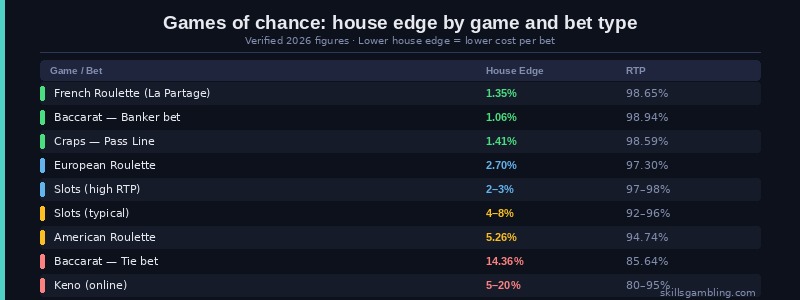
Verified house edges for major games of chance in 2026:
| Game | Bet Type | House Edge | RTP |
|---|---|---|---|
| French Roulette | Even-money (La Partage) | 1.35% | 98.65% |
| European Roulette | All bets | 2.70% | 97.30% |
| American Roulette | All standard bets | 5.26% | 94.74% |
| American Roulette | Top line (0, 00, 1, 2, 3) | 7.89% | 92.11% |
| Baccarat | Banker bet | 1.06% | 98.94% |
| Baccarat | Player bet | 1.24% | 98.76% |
| Baccarat | Tie bet | 14.36% | 85.64% |
| Craps | Don’t Pass / Pass Line | 1.36–1.41% | ~98.6% |
| Craps | Proposition bets | Up to 16.67% | Varies |
| Slots (typical) | All spins | 2–8% | 92–98% |
| Keno (online) | All bets | 20–35% | 65–80% |
| Lottery | All tickets | ~50% | ~50% |
Why You Can’t Win Long-Term at Games of Chance
The law of large numbers guarantees that over sufficient trials, your actual results converge on the mathematical expectation. A roulette player might be ahead after 50 spins. After 50,000 spins, their results will be very close to the expected loss of 2.70% per bet (European wheel) or 5.26% (American).
This is not bad luck. It’s mathematics working exactly as designed. Understanding how the house edge works in every casino game is the single most useful piece of knowledge any casino player can have.
Roulette: The Archetypal Game of Chance
Roulette is the game most associated with casino gambling — and with good reason. It’s transparent, visually compelling, and its mathematics are easy to understand once you know what to look for.
How It Works
A croupier spins the wheel and launches the ball in the opposite direction. As the wheel slows, the ball drops into one of the numbered pockets. Players bet on where it will land — a specific number, a range of numbers, a colour, or an odd/even outcome — before the spin begins.
The outcome is entirely determined by physics. Wheel speed, ball trajectory, deflector positions, and minor environmental variables combine to produce a result that is, for all practical purposes, random.
The Three Variants and Why They Matter
The biggest decision in roulette isn’t where to bet — it’s which wheel to play at.
European Roulette: 37 pockets (1–36 plus one zero). House edge: 2.70% on all standard bets. RTP: 97.30%.
French Roulette: Same 37-pocket wheel as European, but with the La Partage rule — when zero is hit, even-money bets (Red/Black, Odd/Even, High/Low) return half their stake. This halves the house edge on those bets to 1.35%. The best standard roulette available.
American Roulette: 38 pockets — the standard 1–36 plus both zero and double-zero. House edge: 5.26%. The five-number “top line” bet (0, 00, 1, 2, 3) carries 7.89% — the worst standard bet on any roulette table. Avoid this variant whenever European or French is available.
The choice between European and American roulette is worth more than any betting system ever devised.
What Skill Exists in Roulette
Limited but real:
- Variant selection — choosing French over American is measurable in percentage points of house edge
- Bet selection — all standard bets on the same wheel carry the same house edge, but inside bets produce higher variance than outside bets. Matching variance to your bankroll and session goals is a genuine decision
- Bankroll management — stake sizing and session limits determine how long you can play and how much variance you absorb
What skill does not do: predict where the ball lands. No system, no observation of past results, no wheel-reading method changes the outcome of any future spin.
Slot Machines: Pure RNG, Pure Chance
Online slot machines are the clearest example of a game of pure chance. Every spin is determined by a certified Random Number Generator — an algorithm that produces statistically independent outcomes with no connection to any previous spin.
How RNG Works
The RNG continuously generates numbers thousands of times per second, even between spins. When you press the spin button, the most recently generated number is used to determine the outcome. This means timing, button speed, or any other player action has zero influence on results. The outcome is determined before the reels even start moving.
Licensed online slot RNGs are audited by independent testing laboratories (eCOGRA, iTech Labs, BMM) to verify that results are statistically random and match the published RTP.
RTP in Slots
Slot RTP varies dramatically by game:
- High RTP slots (97%+): Blood Suckers (98%), Mega Joker (up to 99%), Starmania (97.87%)
- Typical modern slots: 94–96% RTP
- Jackpot slots: Often 92–94% base RTP, with a portion of every bet funding the progressive jackpot
- Low-end / regional market slots: As low as 80% RTP in some jurisdictions
RTP is the single most important number for slot players. Two otherwise identical slot sessions at 98% vs 94% RTP produce meaningfully different expected costs over volume.
What Skill Exists in Slots
- Game selection — choosing higher-RTP games is the only mathematically meaningful slot decision
- Volatility matching — high-volatility slots produce rare large wins; low-volatility slots produce frequent small wins. Neither is mathematically better, but matching volatility to your bankroll prevents ruin before your RTP expectation plays out
- Bankroll management — stake sizing and session limits are the only levers a slot player genuinely controls
What skill does not do: influence the outcome of any spin. No timing pattern, no “hot machine” theory, no bonus-hunting system changes where the reels stop.
Baccarat: Near-Zero Skill, Near-Zero Edge
Baccarat has an unusual combination of features: very low house edge on the main bets and almost zero skill requirement. It’s one of the better-value casino games precisely because player decisions barely exist.
How It Works
The dealer follows fixed drawing rules — players don’t make decisions about hitting or standing. Your only choice is which of three outcomes to bet on:
- Banker: House edge 1.06% (best bet in baccarat)
- Player: House edge 1.24%
- Tie: House edge 14.36% — avoid entirely
The optimal baccarat strategy is simple: always bet Banker, never bet Tie. That’s it. There are no further skill dimensions.
The Tie Bet Problem
The Tie bet’s 14.36% house edge is extraordinary for a table game — nearly three times worse than American roulette and orders of magnitude worse than the Banker bet sitting next to it. It pays 8:1 but the true probability of a tie is approximately 9.5%. The gap between payout and true odds is the house’s profit. Avoiding the Tie bet is the single most important baccarat decision.
Craps: Chance With Smart Bet Selection
Craps is a dice game with an unusually wide range of bet qualities — from some of the best odds at any casino table to some of the worst. The dice outcome is entirely random; the skill is knowing which bets to make.
The Best Bets in Craps
Pass Line / Don’t Pass: House edge 1.41% / 1.36%. The foundation of any craps session. Low house edge, simple to understand.
Odds Bets: Taken behind the Pass/Don’t Pass line, Odds bets carry zero house edge — the only such bet in any casino game. They pay at true probability with no margin. The catch: you must have a Pass Line bet to place Odds, and most casinos limit the multiple you can place. When available, always take maximum Odds.
Come / Don’t Come: Identical house edge to Pass/Don’t Pass, applied to subsequent rolls.
The Worst Bets in Craps
| Bet | House Edge |
|---|---|
| Any Seven | 16.67% |
| Any Craps | 11.11% |
| Hardways (6 or 8) | 9.09% |
| Hardways (4 or 10) | 11.11% |
| Field Bet (2:1 on 12) | 5.56% |
The proposition bets at the centre of the craps table carry house edges of 9–16%. They generate the most excitement and the worst mathematics. Experienced craps players avoid them entirely.
Keno and Lottery: The Highest House Edges Available
Keno and lottery represent the extreme end of the chance spectrum — high variance, low RTP, and no skill dimension whatsoever.
Keno
Keno is a lottery-style game where players select numbers and hope they match randomly drawn balls. The house edge is extraordinarily high:
- Traditional brick-and-mortar keno: House edge of 25–50%, depending on paytable. Some casinos in less competitive markets run keno at RTP of just 65–75%.
- Online / video keno: Better than traditional, typically 80–95% RTP — but still among the worst-value games online
- House edge range: 5–35% depending on format and paytable
Keno’s appeal is the occasional large payout from a small stake. Its mathematical reality is that it costs significantly more per pound wagered than any mainstream table game. It’s entertainment with a high price tag.
Lottery
National and state lotteries typically return approximately 50% of revenue to players as prizes — a house edge of roughly 50%. The remaining revenue funds government programmes or lottery operator profits. Lottery tickets carry the worst expected value of any legal gambling activity.
The lottery’s appeal is the life-changing jackpot size. Mathematically, a lottery ticket is worth approximately 50p for every £1 spent, regardless of the jackpot size — because the probability of winning scales inversely with the prize.
The Myths That Cost Players Money
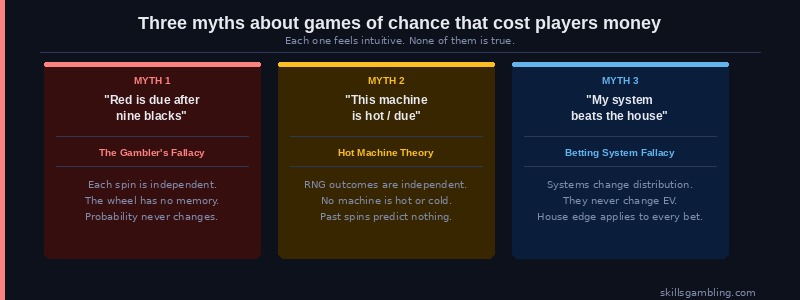
Myth 1: “Red is due after nine blacks”
The Gambler’s Fallacy — the belief that random outcomes are influenced by previous results. In European roulette, the probability of red on any spin is always 18/37 = 48.65%, regardless of what came before. The wheel has no memory.
Research published in 2025 by Xiang, Dorst, and Gershman confirmed that the Gambler’s Fallacy affects both experienced and inexperienced gamblers even when they can correctly calculate the true probability.
Myth 2: “This machine is hot / due a payout”
Slot machines use certified RNGs producing statistically independent outcomes. A machine that hasn’t paid a jackpot in six months has exactly the same jackpot probability on the next spin as it did six months ago. There is no “hot” or “cold” machine — only a machine that has generated different past outcomes, which carry no predictive information about future ones.
Myth 3: “Betting systems beat the house”
The Martingale, Fibonacci, D’Alembert, Labouchère — every progression system ever devised makes the same implicit promise: that changing your stake sizes changes your expected outcome. They don’t. The expected value of every bet is determined by the house edge on that specific game and bet type. Doubling after a loss changes the distribution of wins and losses across a session. It does not change the expected value of any individual bet.
No betting system has ever been shown to produce long-run positive expected value on a negative-EV game. The mathematics is settled on this question.
Myth 4: “Online casinos rig games against you”
At licensed, regulated online casinos, no. RNG certification by independent testing laboratories (eCOGRA, iTech Labs, GLI) verifies that game outcomes match the published RTP within statistical tolerance. Casinos profit from the house edge — they don’t need to manipulate individual results, and doing so would risk regulatory sanctions and loss of licence.
The caveat: this only applies to licensed casinos operating under credible regulatory frameworks (UK Gambling Commission, Malta Gaming Authority, Gibraltar Regulatory Authority, New Jersey DGE). Unlicensed offshore operators have no such accountability.
Myth 5: “I can read the roulette wheel”
Wheel-reading — identifying physical biases in a wheel that cause certain numbers to hit more than probability predicts — was a legitimate technique applied to poorly maintained wheels in 20th-century casinos. Modern casino wheels are manufactured to precision tolerances and regularly inspected. Online live dealer wheels additionally use auto-release ball mechanisms and scheduled maintenance. In 2026, at regulated online casinos, exploitable wheel bias does not exist in practice.
Where Skill Ends and Chance Begins
The most honest framing for games of chance is this: skill influences the cost of playing, not the outcome of events.
In roulette, choosing French over American costs you less per session. That’s a skill decision with a measurable mathematical impact. But neither choice influences where the ball lands on any given spin.
In slots, choosing a 98% RTP game over a 94% RTP game costs you less over volume. That’s a skill decision. But it doesn’t influence which symbols appear on any spin.
In baccarat, always betting Banker and never betting Tie costs you less than random bet selection. That’s a skill decision. But it doesn’t influence which cards are drawn.
The line is clear: decisions that affect the mathematical structure of the game (which game, which bet type) are within the player’s control. The random event itself — ball, reel, card, dice — is not.
For games where skill genuinely moves the needle beyond bet selection, see our skill-based casino games guide and our detailed analysis of overcoming the house edge.
How to Minimise Your Cost When Playing Games of Chance
Since the house edge is fixed and the outcome is random, the only levers available to a player are structural and behavioural.
Choose the Right Variant
This is the highest-impact decision. The difference between French Roulette (1.35%) and American Roulette (5.26%) on even-money bets is 3.91 percentage points — nearly four times the cost per bet. No session discipline, no betting system, and no strategy produces improvements of that magnitude.
Priority order for variant selection:
- French Roulette with La Partage (even-money bets) — 1.35%
- European Roulette — 2.70%
- Baccarat Banker — 1.06%
- Craps Pass Line with maximum Odds — approaches 0% on Odds portion
- High-RTP slots (97%+) — check the paytable before playing
Stake Sizing and Session Management
The expected cost of a session is: house edge × total amount wagered.
At 2.70% house edge, wagering £1,000 across 100 spins at £10 per spin costs approximately £27 on average. The same session at £5 per spin costs approximately £13.50. Lower stakes per spin extend your session and reduce expected loss proportionally.
Bankroll management principles applied to games of chance means setting a session budget before you start and treating it as absolute — not as a starting point for negotiation with yourself when you’re losing.
Avoid the Worst Bets
Within any game, some bets are structurally worse than others:
- Roulette top line (0, 00, 1, 2, 3): 7.89% — never place it
- Baccarat Tie bet: 14.36% — never place it
- Craps proposition bets: 9–16% — avoid entirely
- Slot side bets: typically 5–15% — skip them
- Keno: if playing at all, online video keno (80–95% RTP) over traditional keno (50–75% RTP)
Know When to Stop
Variance means you will sometimes be significantly ahead during a losing session. The ability to stop while ahead requires a preset win target — made before you start playing, not during the session. Deciding to “play a little longer while I’m up” is how winning sessions become losing ones.
Responsible Gambling
No system, strategy, or game selection eliminates the house edge. All games of chance involve financial risk. The mathematical expectation over sufficient volume is a net loss.
Games of chance are a form of entertainment with a price. That price is the house edge applied to the total amount you wager. Understanding this clearly — not optimistically — is the foundation of gambling responsibly.
Signs That Gambling May Be Becoming Harmful
- Playing with money you cannot afford to lose
- Continuing to play to recover losses
- Gambling affecting financial obligations, relationships, or wellbeing
- Finding it difficult to stop when you intend to
These are not signs that you need a better strategy. They are signs that gambling has moved from entertainment to a problem.
Support Resources
- GamCare (UK): gamcare.org.uk / 0808 8020 133 (free, 24/7)
- BeGambleAware: begambleaware.org
- GAMSTOP (UK self-exclusion): gamstop.co.uk
- Gamblers Anonymous: gamblersanonymous.org.uk
- National Problem Gambling Helpline (US): 1-800-522-4700
FAQ
What is a game of chance?
A game of chance is any gambling activity where the outcome is determined primarily by random processes — dice, spinning wheels, cards, or RNG software — rather than the player’s decisions or skill. The defining characteristic is that better decisions by the player do not produce better long-run outcomes in terms of the random event itself.
Can you beat games of chance long-term?
No. The house edge ensures that over sufficient volume, the casino retains a fixed percentage of all money wagered. Individual players win in the short term through variance — but variance averages out over large samples. No strategy changes the mathematical expectation built into the game’s structure.
What is the lowest house edge game of chance?
French Roulette with La Partage or En Prison rules carries a 1.35% house edge on even-money bets — the lowest of any standard game of pure chance. Baccarat’s Banker bet at 1.06% is technically lower but the 5% commission on Banker wins makes the net house edge approximately equal. Craps with maximum Odds behind the Pass Line approaches 0% on the Odds portion but requires the Pass Line bet (1.41%) to access it.
Is roulette better than slots?
By house edge, European Roulette (2.70%) is better than most slots (typical 4–8%). French Roulette (1.35% on even-money) is significantly better. High-RTP slots at 97–98% are comparable to European Roulette. Game selection within slots varies more dramatically than within roulette — a 97% RTP slot beats American Roulette (5.26%) clearly.
Does the Martingale system work?
No. The Martingale — doubling after each loss to recover losses on the next win — changes the distribution of wins and losses across a session but does not change the expected value of any individual bet. The house edge applies to every bet regardless of stake size. Table limits and finite bankrolls create upper bounds on the system; during a sufficient losing streak the system collapses before mathematical recovery.
Why do people keep playing if the house always wins?
Variance. In the short run, players win. Even with a 5% house edge, a player can win significantly over a single session. The variance in games of chance is large enough that winning sessions happen regularly — which reinforces play through positive reinforcement. The house edge only becomes deterministic over very large samples, which most recreational players never reach in a single game.
What is the difference between RTP and house edge?
They are two ways of expressing the same mathematical relationship. RTP (Return to Player) is the percentage of all wagered money returned to players over time. House edge is the percentage the casino retains. They sum to 100%. A game with 97.3% RTP has a 2.7% house edge. A game with a 5.26% house edge has a 94.74% RTP.
Conclusion
Games of chance are honest about what they are. The mathematics is fixed, the house advantage is real, and no strategy changes those fundamental facts.
What players can do is approach games of chance with clear eyes:
- Choose variants with the lowest house edge — this single decision has more impact than any system or strategy
- Place bets within those games that don’t carry structurally worse odds than necessary
- Manage stakes so that variance doesn’t end sessions prematurely
- Set loss limits before starting and treat them as non-negotiable
- Understand that variance creates winning sessions even in negative-EV games — and that those winning sessions don’t indicate a strategy is working
Games of chance work differently from skill-based gambling games — but they can still be approached intelligently. The intelligence isn’t in predicting outcomes. It’s in understanding the mathematics well enough to make every controllable decision correctly.
Related Reading
- Skill-Based Casino Games: Where Your Decisions Actually Matter
- Can Skill Overcome the House Edge?
- House Edge Explained: What It Is and How It Works
- Online Roulette: The Definitive Guide to Playing Smarter
- Bankroll Management: The Strategy That Protects Every Other Strategy
- Expected Value in Gambling: The Complete Guide
- Skill vs Luck: What Actually Determines Your Results
SkillsGambling.com is an educational resource. Nothing published here constitutes financial advice or a guarantee of gambling outcomes. Gambling involves financial risk. Please gamble responsibly. 18+ only.