
Reading time: ~8 minutes | Last updated: June 2026
Quick Answer: Online skill games for money are games where player ability, strategy, and practice directly determine results over time. Unlike casino games of chance where the outcome is fixed by RNG or physics, skill games reward players who are genuinely better than their opponents. The clearest examples available online are backgammon, mahjong, dominoes, and patience solitaire — traditional games with centuries of competitive history that can now be played for real money against other players on dedicated platforms.
Table of Contents
- What Makes a Game a Genuine Skill Game?
- The Four Classic Online Skill Games for Money
- Backgammon: Strategy, Probability, and Position
- Mahjong: Pattern Recognition and Tactical Play
- Dominoes: Reading the Board and Controlling the Game
- Patience Solitaire: Decision-Making Under Constraint
- How Online Skill Game Platforms Work
- Skill Games vs Casino Games: The Key Difference
- Responsible Gambling
- FAQ
What Makes a Game a Genuine Skill Game?
The test is straightforward: do better players win more consistently over a large enough sample?
In a pure game of chance — a slot machine, a roulette wheel — the answer is no. The outcome is determined by randomness, and no amount of practice, knowledge, or strategy changes the probability of any individual event. The best and worst player in the world face the same expected outcome per spin.
In a genuine skill game, the answer is yes. A better backgammon player beats a weaker one more often than chance alone would predict. A stronger mahjong player recognises winning patterns faster and makes fewer costly discards. Over hundreds of games, the skill gap becomes statistically undeniable.
This is the same principle that makes poker skill-dominant over large samples — and the same principle that applies to the traditional skill games covered on this page. For a detailed breakdown of where skill and luck sit across all forms of gambling, see our skill vs luck in gambling guide.
“The difference between a skill game and a game of chance is not whether luck is involved — it’s whether better decisions produce better outcomes over time.”
Player vs Player — Not Player vs House
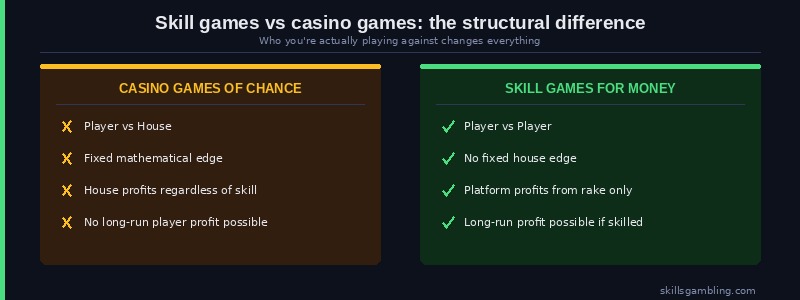
The other defining feature of online skill games for money is the competitive structure. You are playing against other people, not against a house edge. The platform takes a rake or entry fee — similar to how poker rooms operate — but the money you win comes from less skilled opponents, not from a fixed mathematical disadvantage.
This means that a genuinely skilled player can achieve positive expected value over time. Not guaranteed profits — variance still produces losing sessions — but a measurable, sustainable edge against weaker opponents. This is categorically different from casino games of chance where the house edge prevents long-run profitability regardless of skill.
The Four Classic Online Skill Games for Money
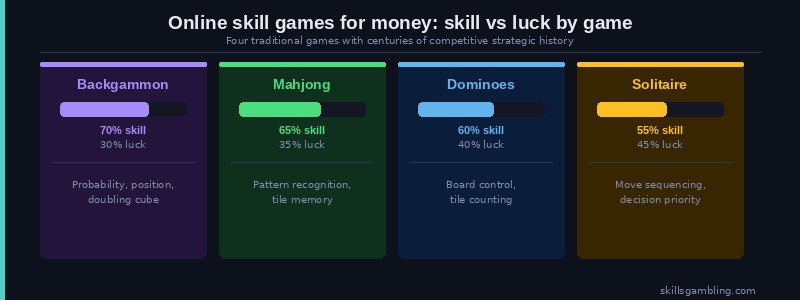
The games covered on this page share several characteristics:
- Centuries of competitive history — their depth of strategic play is documented and studied
- Clear skill gradients — beginners, intermediate, and expert players produce measurably different results
- Available on dedicated online platforms where real money can be wagered against other players
- Governed by probability, memory, pattern recognition, and strategic thinking — not random number generators
| Game | Primary Skills | Skill vs Luck Balance | Available Online |
|---|---|---|---|
| Backgammon | Strategy, probability, position | ~70% skill / 30% luck | Yes — multiple platforms |
| Mahjong | Pattern recognition, memory, tactics | ~65% skill / 35% luck | Yes — multiplayer platforms |
| Dominoes | Board reading, tile counting, blocking | ~60% skill / 40% luck | Yes — multiplayer platforms |
| Patience Solitaire | Decision-making, sequencing | ~55% skill / 45% luck | Yes — competitive platforms |
Backgammon: Strategy, Probability, and Position
Backgammon is one of the oldest board games in the world — its origins trace back over 5,000 years — and one of the most skill-intensive games available for real money play online.
Where the Skill Lives
Pip counting and probability: Every backgammon position has calculable probabilities. Knowing your pip count relative to your opponent’s, the likelihood of specific dice combinations, and the probability of being hit from various positions allows skilled players to make mathematically superior decisions.
Position and structure: Building primes (consecutive points that trap opponent checkers), controlling key points, and understanding when to play for gammons versus simply winning the game are strategic dimensions that separate experienced from novice players.
The doubling cube: The cube is where backgammon skill is arguably most concentrated. Knowing when to offer a double, when to accept, and when to beaver requires understanding both the current position and the probability landscape of likely future positions. The doubling cube creates leverage that skilled players exploit systematically against weaker opponents.
Bearing off efficiency: The endgame — bearing checkers off the board — involves calculating optimal moves to minimise wasted pips and maximise bearing-off speed. Small errors here cost games that should be won.
Where Luck Remains
Dice rolls are random. No strategy eliminates the possibility of repeated bad dice changing a game’s outcome. Over any single game, luck plays a significant role. Over hundreds of games against the same opponent, the skill differential becomes the dominant factor.
For a full guide to playing backgammon for real money online, see our backgammon for money guide.
Mahjong: Pattern Recognition and Tactical Play
Mahjong is a tile-based game originating in China, now played competitively worldwide in multiple variants. The standard game involves 144 tiles drawn and discarded in turns, with players building winning hands from specific tile combinations.
Where the Skill Lives
Hand reading: Experienced mahjong players track which tiles have been discarded, use that information to infer which tiles opponents are holding, and adjust their own strategy accordingly. Knowing which tiles are safe to discard — and which are likely to complete an opponent’s hand — is the central tactical skill.
Hand efficiency: Calculating the fastest path to a winning hand, and knowing when to abandon one hand structure in favour of another based on available tiles, requires pattern recognition developed through extensive play.
Risk management: Deciding whether to push for a high-value winning hand versus a faster but lower-value one — particularly when opponents are close to winning — is a recurring strategic tension that separates skilled from casual players.
Tile memory: Tracking all tiles that have been played and remaining in the wall is a significant memory skill that improves with practice and directly informs probability calculations.
Where Luck Remains
Which tiles are drawn from the wall is random. A skilled player with poor tile draws loses to a weaker player with good ones in any individual game. The skill advantage compounds over many games.
For real money mahjong online, see our mahjong for money guide.
Dominoes: Reading the Board and Controlling the Game
Dominoes is a tile-placement game played in numerous variants worldwide — Block Dominoes, Draw Dominoes, and Pai Gow among the most common. In competitive money play, the ability to control the board and count tiles is the defining skill.
Where the Skill Lives
Tile counting: Experienced domino players track which tiles have been played and use deductive reasoning to identify what tiles opponents are holding. This is the single most impactful skill available — knowing what your opponents have narrows the decision space significantly.
Board control: Placing tiles to restrict opponent options — blocking numbers they need, keeping the board open for yourself — is a strategic dimension absent from pure chance games.
End-game calculation: Knowing when to play defensively versus aggressively, and calculating pip counts as the game nears completion, produces measurably better results for skilled players.
Reading opponent tendencies: Like poker, experienced domino players identify patterns in how opponents play — tiles they’re reluctant to play, suits they appear strong in — and adjust accordingly.
Where Luck Remains
Which tiles are drawn at the start is random. The initial draw significantly influences each individual game’s outcome. Over many games, player skill becomes the dominant factor.
See our dominoes for money guide for platforms and strategy.
Patience Solitaire: Decision-Making Under Constraint
Patience (known as Solitaire in North America) is typically thought of as a single-player game — but competitive platforms have created head-to-head and tournament formats where the same dealt hand is given to multiple players simultaneously, and ranking is determined by completion time or score.
Where the Skill Lives
Move sequencing: Many solitaire hands have multiple valid move sequences, but only some lead to completion. Skilled players identify the most efficient sequences faster, wasting fewer moves on dead ends.
Decision prioritisation: Knowing which moves to make early — particularly around uncovering face-down cards and creating empty columns in Klondike — has significant downstream effects on whether a hand is completable.
Pattern recognition: Experienced players recognise hand configurations that are likely to become stuck and adjust their approach early, rather than committing to sequences that lead to dead ends.
Where Luck Remains
The deal is random. Not all hands are completable regardless of skill level. In competitive formats, all players receive the same deal — removing luck from the competitive comparison and isolating skill as the differentiating factor.
For platforms and competitive formats, see our patience solitaire for money guide.
How Online Skill Game Platforms Work
Online skill games for money operate on platforms distinct from standard online casinos. The key structural differences:
Player vs player: You compete against other human players, not against a house algorithm. The platform’s revenue comes from rake, entry fees, or tournament buy-ins — not from a mathematical edge on game outcomes.
Matchmaking: Most platforms use rating systems (similar to chess ELO ratings) to match players of comparable skill levels. This prevents experts from systematically farming beginners and keeps competition meaningful.
Tournaments: Structured tournament formats with fixed buy-ins and prize pools are common across all four games. Entry fees fund the prize pool minus the platform’s commission.
Rake structure: Platforms typically take 5–15% of cash game pots or tournament prize pools as their fee. Understanding the rake structure is important — high rake reduces the effective return for winning players over volume.
Legal status: The legal classification of skill games for money varies by jurisdiction. In most common law countries, games where skill is the predominant factor are treated differently from games of chance under gambling law. Always verify the legal status in your jurisdiction before playing for real money.
Most platforms use rating systems similar to those formalised by the World Chess Federation to match players of comparable skill levels.
Skill Games vs Casino Games: The Key Difference
This is worth being direct about, because the distinction matters enormously for long-run expectations.
Casino games of chance (slots, roulette, baccarat, keno) have a permanent house edge built into their mathematical structure. No strategy eliminates this edge. The expected outcome for any player over sufficient volume is a loss proportional to the house edge percentage. Understanding how the house edge works in casino games explains exactly why this is unavoidable.
Skill games for money do not have a fixed house edge against the player. The platform takes a fee, but your long-run results depend on your skill relative to your opponents. Better players win. Over sufficient volume, the skill differential is the dominant factor.
The practical implication: skill games for money offer something casino games cannot — the genuine possibility of long-run positive expected value for players who are better than their competition.
The caveat: you must actually be better than your opponents for this to hold. Playing backgammon for money against stronger players produces consistent losses regardless of whether it’s a skill game.
Responsible Gambling
Skill games for money involve real financial risk. Past results do not guarantee future performance. Even skilled players experience losing runs due to variance.
The player-vs-player structure of skill games means that your expected results depend on the skill level of your competition — which you may not be able to accurately assess, particularly when starting out on a new platform.
Play within limits you can afford to lose. If gambling is affecting your financial wellbeing or relationships, please use these resources:
- GamCare (UK): gamcare.org.uk / 0808 8020 133 (free, 24/7)
- BeGambleAware: begambleaware.org
- GAMSTOP (UK self-exclusion): gamstop.co.uk
- National Problem Gambling Helpline (US): 1-800-522-4700
FAQ
What are online skill games for money?
Online skill games for money are competitive games where player ability — strategy, knowledge, and practice — is the primary determinant of long-run results. Unlike casino games of chance where the house holds a permanent mathematical edge, skill games pit players against each other. The most widely available examples are backgammon, mahjong, dominoes, and patience solitaire on dedicated competitive platforms.
Can you actually win money playing skill games online?
Yes — if you are genuinely more skilled than your opponents over a meaningful sample of games. Skill games for money have no fixed house edge against the player. The platform takes a rake or entry fee, but winnings come from less skilled opponents. Variance means short-term results fluctuate, but skilled players produce positive results over time.
Are online skill games legal?
In most jurisdictions, games where skill is the predominant factor are treated differently from games of pure chance under gambling law. However, the legal status varies significantly by country and region. Always verify the legal status of online skill games for money in your specific jurisdiction before playing.
What is the most skill-intensive online game for money?
Backgammon has the deepest skill dimension of the four games covered here, combining probability calculation, positional strategy, and doubling cube decisions. It also has the most developed competitive ecosystem online. Chess is arguably the most purely skill-based game but is not typically available for direct money play on mainstream platforms.
How do platforms make money from skill games?
Platforms take a rake — a percentage of each pot in cash games, typically 5–15% — or charge entry fees for tournaments. Unlike casinos, they profit the same amount regardless of which player wins, creating no incentive to manipulate outcomes.
Do I need experience to play skill games for money?
No — but playing without experience against experienced opponents produces consistent losses. Most platforms have beginner tables or low-stakes options where new players can develop their game before moving to higher stakes. Starting at the lowest available stakes while learning the game’s strategic depth is the correct approach.
Related Reading
- Play Backgammon for Money
- Play Mahjong for Money
- Play Dominoes for Money Online
- Play Patience Solitaire for Money
- Skill vs Luck in Gambling: What Actually Determines Results
- Skill-Based Casino Games: Where Your Decisions Actually Matter
- Can Skill Overcome the House Edge?
SkillsGambling.com is an educational resource. Nothing published here constitutes financial advice or a guarantee of gambling outcomes. Gambling involves financial risk. Please gamble responsibly. 18+ only.