
Quick Answer
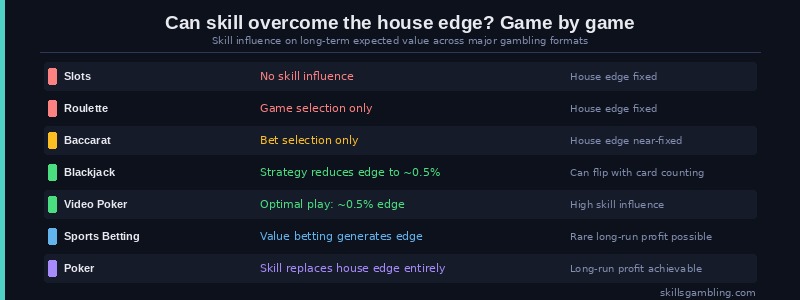
In most casino games, no — skill cannot fully overcome the house edge. The mathematics are fixed, and no decision-making process removes them entirely. But the picture is more nuanced than a flat no. In blackjack, skill reduces the house edge dramatically and card counting can theoretically flip it. In poker, the house edge works differently — and skilled players can beat it consistently. In sports betting, a small number of professionals with genuine analytical edge do overcome the built-in margin over time. The honest answer is: it depends entirely on the game, and the bar is higher than most gambling content will admit.
Introduction
The house edge is one of those concepts that sounds simple until you start asking detailed questions about it.
Everyone knows the casino has an advantage. Fewer people know exactly how large it is in each game. Fewer still know how much skill can actually compress it — and in which games the edge can, at least theoretically, be flipped.
This article answers those questions directly. We’ll cover what the house edge actually is, how skill interacts with it across different games, and what it genuinely takes to be on the right side of the maths in the long run. No miracle systems. No unrealistic claims. Just the kind of clear, direct analysis that helps you make smarter decisions about where you play and how you play.
What Is the House Edge, Exactly?
Before we talk about overcoming it, it helps to understand precisely what you’re up against.
The house edge is the percentage of every bet the casino expects to keep over time — expressed as a long-run average across millions of bets. It’s not about any single hand or spin. It’s about the mathematical architecture of the game.
Here’s a simple example. European roulette has a house edge of 2.7%. That means for every £100 wagered across a large enough sample, the casino expects to retain £2.70. You might win £200 in a single session. You might lose £400 the next. But over tens of thousands of spins, the results converge on that 2.7% loss rate for the player — consistently and reliably.
“The house edge isn’t a threat. It’s a tax. The question is whether skill can reduce the tax rate — or, in rare cases, eliminate it entirely.”
The key phrase is over time. Short-run variance creates plenty of winners and losers regardless of the underlying maths. The house edge only becomes deterministic across very large samples.
House Edge by Game: A Reference Point
| Game | Typical House Edge | Skill Influence |
|---|---|---|
| Slots | 2–15% | Minimal (game & RTP selection only) |
| American Roulette | 5.26% | Negligible |
| European Roulette | 2.70% | Negligible |
| Baccarat (Banker bet) | 1.06% | Very limited |
| Craps (Pass line) | 1.41% | Limited |
| Blackjack (poor strategy) | 2–4% | High |
| Blackjack (basic strategy) | ~0.5% | High |
| Blackjack (card counting) | −0.5 to +1% | Very high |
| Video Poker (optimal play) | 0.5–1% | High |
| Poker (vs house rake) | 2–10% rake per pot | Very high |
| Sports betting (vs vig) | 4–10% vig | High — but difficult |
The table tells the story clearly. The games where skill matters most are also the games with the lowest starting house edge — or, in poker’s case, a fundamentally different competitive structure.
The Three Ways Skill Interacts With House Edge
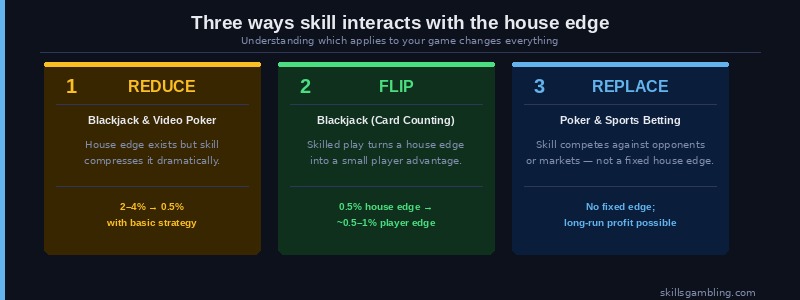
It helps to separate skill’s role into three distinct categories. They’re often conflated, and that conflation leads to unrealistic expectations.
1. Skill Reduces the House Edge
This is what happens in blackjack and video poker. The house edge exists regardless of your decisions, but how much of it you face is entirely within your control.
A blackjack player making random or intuitive decisions hands the casino an edge of around 2–4% depending on the specific rules at that table. A player applying mathematically correct basic strategy reduces that edge to approximately 0.5%. That’s a meaningful compression — you’re losing four to eight times slower than the uninformed player at the same table.
This is where skill pays off most reliably for recreational players. You don’t need to become a professional. You don’t need to spend months studying. Learning basic strategy takes a few focused hours and immediately changes your expected value in a material way.
2. Skill Can Flip the House Edge
This is rarer, harder, and subject to real-world constraints — but it’s genuine.
Card counting in blackjack allows skilled players to track the ratio of high-value to low-value cards remaining in the shoe. When the composition of the remaining deck favours the player, a counter increases their bet. When it doesn’t, they bet the minimum. Executed correctly, this can turn a 0.5% house edge into a small player advantage — typically estimated at 0.5% to 1% in realistic conditions.
That sounds modest. Over significant volume at reasonable stakes, it’s not.
The catch: casinos know exactly what card counting looks like. Trained surveillance staff, bet spread detection software, and continuous shuffle machines all exist specifically to neutralise it. A skilled counter working today faces a persistent cat-and-mouse game — and casinos can and do refuse service to anyone they identify as an advantage player.
“Card counting is legal. It is not cheating. But exercising a legal skill can still get you banned — and that’s a practical constraint no amount of technique overcomes.”
3. Skill Replaces the House Edge Entirely
This is the poker model.
In cash games and tournaments, you are not competing against the house. You’re competing against other players. The casino takes a rake — typically 2–10% of each pot, usually capped — but the rake is structural rather than directional. A skilled player who wins pots consistently pays rake, but their winnings come from less skilled opponents, not from a fixed mathematical disadvantage built into every decision.
This is the structural reason why poker is different from every other casino game on the skill-versus-edge question. The house edge in poker is not your enemy in the way it is at a roulette table. Your opponents are. And opponents, unlike maths, can be beaten.
Professional poker players with genuine edge over their player pool can sustain positive ROI measured across thousands of hands. The rake reduces that ROI — which is why game selection and stake level matter significantly — but it does not make long-run profitability impossible the way the house edge in roulette does.
Blackjack: The Clearest Case Study
Blackjack is worth examining in detail because it offers the most direct, quantifiable example of skill compressing a fixed mathematical disadvantage.
Basic Strategy: Essential, Not Optional
Basic strategy is the foundation. It’s a complete decision map — derived from computer simulations of hundreds of millions of hands — that tells you the mathematically optimal play for every combination of your cards versus the dealer’s upcard.
Hit here. Stand there. Double on this. Split those.
Players who don’t use basic strategy are not making suboptimal decisions. They’re leaving significant money on the table hand after hand, session after session. The gap between basic strategy and intuitive play represents roughly 1.5–3.5% of every bet, depending on the game rules.
Basic strategy alone does not overcome the house edge. What it does is minimise it to a level where variance becomes the primary short-term factor rather than poor decision-making. That matters.
Rule Variations Change the Edge
The specific rules at any blackjack table change the house edge independently of your strategy. This is game selection as a skill — and it’s one most recreational players completely ignore.
Key rule factors and their approximate effect on house edge:
- 3:2 vs 6:5 natural blackjack payout: 6:5 pays increases the house edge by approximately 1.4%. Always avoid 6:5 tables.
- Number of decks: Single-deck blackjack carries a lower house edge than 6 or 8-deck games. The difference can be 0.5–0.6%.
- Dealer hits soft 17: This rule increases the house edge by approximately 0.2%. Look for “dealer stands on all 17s.”
- Double after split allowed: Reduces house edge by approximately 0.15%.
- Surrender option: Late surrender (available in many games) can reduce edge by approximately 0.08%.
A player applying perfect basic strategy at a well-chosen 3:2, single-deck table with favourable rules can face a house edge below 0.4%. The same player at a poorly chosen 6:5, 8-deck table faces an edge over 2%. The decision of where to sit matters as much as the decision of how to play.
Card Counting: Real Advantage, Real Constraints
Card counting in blackjack is the most documented case of a player skill actually flipping the edge. The Hi-Lo counting system — the most widely taught — assigns values to cards as they’re dealt, allowing a counter to estimate when the remaining shoe favours the player.
When the count is favourable, a counter spreads their bets. When it’s neutral or negative, they bet the minimum. The correlation between bet size and player advantage is what creates a long-run edge.
What card counting is:
- A legal skill requiring significant practice
- A genuine mathematical edge under the right conditions
- A long-run positive expectation — not a guaranteed session winner
What card counting is not:
- A guarantee of winning any particular hand or session
- Immune to short-run variance (even skilled counters have significant losing stretches)
- Easily practised in most modern casino environments
The practical constraints are real. Continuous shuffle machines make counting impossible. Multi-deck shoes with poor penetration (shuffled early) reduce edge significantly. Surveillance is specifically trained to identify betting patterns consistent with counting. A player who masters card counting today faces a different environment than the one the technique was developed in. The edge exists — but accessing it requires skill, discipline, bankroll, and significant patience.
Card counting has been confirmed by gaming law scholars at the UNLV Center for Gaming Research as a legal advantage play technique — casinos reserve the right to refuse service, but no law prohibits the practice.
Poker: A Different Relationship With the House
The house edge in poker operates differently from every other casino game — and understanding the distinction is essential to understanding why poker is unique on the skill-versus-edge question.
The Rake Is Not Your Primary Obstacle
In poker, the casino’s cut (rake) is taken from pots won — usually 2–10%, often capped at a fixed amount per hand. In cash games, rake is a constant friction cost. In tournaments, it’s built into the buy-in (typically 10–15% of the entry fee goes to the house rather than the prize pool).
Rake is a cost of doing business. It affects your win rate — but it doesn’t create a structural ceiling on long-run profitability the way the house edge does in roulette or baccarat.
Your long-run results in poker are determined by the gap between your decision-making quality and your opponents’ decision-making quality, minus rake. If that gap is large enough, rake doesn’t stop you from being a long-run winner. It just reduces the rate of profit.
“In blackjack, your opponent is a fixed mathematical system. In poker, your opponent is a human being — and humans make mistakes.”
What Skill Looks Like in Poker
The skill dimension in poker is multi-layered in a way that no other gambling game matches:
- Hand selection — knowing which starting hands to play from which position, and which to fold
- Positional awareness — understanding that acting last gives a significant informational advantage
- Expected value thinking — evaluating decisions not on individual outcomes but on long-run mathematical expectation
- Opponent modelling — identifying patterns, tendencies, and exploitable weaknesses in specific players
- Bet sizing — using bet sizes to extract value, apply pressure, and limit opponents’ profitability
- Bankroll management — ensuring your bankroll is large enough to survive the variance inherent in the game
No single session validates or invalidates any of these. Skill in poker is a long-run property, not a session-by-session guarantee.
The Data on Professional Poker ROI
Long-run positive ROI in poker is achievable — but the numbers are more modest than most players expect. Estimates for skilled online players suggest ROI of around 10–30% at lower to mid-stakes, shrinking as competition stiffens at higher levels. Live poker ROI tends to run between 10–15% for strong players, given softer field compositions.
These numbers mean consistent, meaningful profit is achievable — but the sample sizes required before those numbers become statistically reliable are in the tens of thousands of hands, not hundreds.
Sports Betting: Edge Exists, But It’s Rare
Sports betting is frequently discussed as a skill-based gambling activity — and that classification is accurate, with an important qualification.
The built-in margin in sportsbook odds (the vig or juice) typically represents 4–10% of every bet. Overcoming that margin requires not just knowledge of sport, but consistently more accurate probability assessment than the sportsbook’s own models — and the sharp money that moves lines toward efficiency.
What Genuine Edge Looks Like
A professional sports bettor with real edge isn’t just picking winners. They’re identifying mispriced outcomes — situations where their probability assessment differs materially from the implied probability in the available odds.
The most reliable indicator of genuine skill in sports betting is closing line value (CLV): consistently getting bets on at odds better than where the market closes. When a professional bettor consistently beats closing lines, it demonstrates genuine predictive power rather than short-run luck.
Realistic ROI for a professional sports bettor sits at around 4–10% over large samples. That requires a win rate on point spread or similar markets of approximately 55% — against a break-even rate of roughly 52.4% at standard -110 odds.
“Only around 3% of sports bettors are profitable in the long run. The other 97% essentially fund the sportsbooks’ margins.”
The Practical Problem: Sportsbooks Limit Winners
Even genuine edge in sports betting faces an external constraint with no equivalent in casino games: sportsbooks actively limit or ban profitable customers.
An advantage blackjack player can be removed from a casino. An advantage sports bettor faces stake limits that reduce their effective edge to near-zero. Documented professional bettors in multiple markets report being restricted to stakes of £5–£20 per bet — making the mathematical edge commercially irrelevant regardless of its size.
This is a real, practical constraint on monetising skill in sports betting that doesn’t exist in poker. Poker rooms benefit from skilled players driving action — and don’t restrict winning players the way sportsbooks do.
Games Where Skill Cannot Overcome the House Edge
Roulette
Roulette is the clearest case. The ball outcomes are statistically independent random events. No pattern of play, no betting system, no observation of previous results changes the probability of any outcome.
Skill in roulette is limited to:
- Choosing European over American roulette (saves 2.56% per bet)
- Understanding which bets carry which variance profiles
- Sensible bankroll management
Skill does not influence the ball.
No betting system — Martingale, Fibonacci, D’Alembert, or any other progression — changes the underlying expected value. They redistribute wins and losses across a session but produce identical long-run results to flat betting. The house retains its 2.7% (or 5.26%) regardless.
Slots
Modern slots run on certified RNGs. Individual spin outcomes are random and uninfluenced by previous results or any player decision.
Skill influences:
- RTP selection — a 97% RTP machine loses money more slowly than a 92% RTP machine
- Volatility matching — choosing a variance profile suited to your bankroll
- Avoiding side bets and bonus bets with inflated house edges
Skill does not influence:
- Any individual spin outcome
Baccarat
Baccarat offers essentially one meaningful decision: which bet to place. The Banker bet at 1.06% house edge is the correct choice. The Tie bet at approximately 14% is not. Beyond that, the card outcomes are fixed by the drawing rules — no decision by the player changes them.
Pros and Cons: The Honest Summary
| Skill Benefit | Limitation | |
|---|---|---|
| Blackjack (basic strategy) | Reduces house edge to ~0.5% | House edge remains; not eliminated |
| Blackjack (card counting) | Can create small player edge | Casinos actively counter it; impractical in many environments |
| Poker | Can fully overcome rake with skill | Requires large sample; steep learning curve; brutal variance |
| Sports betting | Genuine edge is possible | Sportsbooks limit winners; only ~3% profitable long-term |
| Roulette | Game selection reduces edge | Skill cannot influence outcomes |
| Slots | RTP selection helps | Cannot influence any spin |
| Baccarat | Bet selection matters | Skill ceiling extremely low |
Expert Insight: The Right Mental Model
The question “can skill overcome the house edge?” is almost always asked by someone who wants a yes — and in specific games and contexts, the honest answer is closer to yes than many people realise. But the framing matters.
Skill doesn’t eliminate variance. Even a card counter with a genuine 1% edge will have losing sessions, losing months, and occasionally losing years. Even a skilled poker player will experience extended downswings that look indistinguishable from losing. The skill only shows up clearly in the long run — and the long run is longer than most people expect.
Skill has practical constraints. Card counting works mathematically but faces practical friction from casino countermeasures. Sports betting edge works mathematically but faces stake limits from operators. The existence of a mathematical edge and the ability to act on it profitably are two different things.
Game selection is itself a skill. Choosing to play blackjack instead of roulette, choosing a 3:2 table over 6:5, choosing a poker game with weaker competition — these decisions are all forms of skill applied before a single hand is dealt. They may produce more long-run impact than any in-game decision.
The bar is high. Basic strategy in blackjack is accessible. Card counting is genuinely difficult and practically constrained. Positive-ROI poker requires better-than-average decision-making across tens of thousands of hands. Profitable sports betting requires analytical edge against a highly sophisticated market. Understanding the bar honestly is itself valuable information.
Responsible Gambling
Understanding the relationship between skill and house edge is educational. It doesn’t remove the financial risk that gambling carries.
No gambling strategy guarantees profit. Even players with genuine mathematical edge lose money in specific time periods. Variance creates real swings, and past performance tells you nothing reliable about future results in any short run.
Gambling should be an entertainment activity, not a financial strategy. The skill element in certain games makes them more engaging intellectually and can reduce the rate of loss for informed players — but it does not eliminate risk, and it does not guarantee income.
If you find that gambling is no longer feeling like entertainment, or that the financial stakes are creating pressure rather than enjoyment, the tools to address that are available and free to use: deposit limits, session time limits, cooling-off periods, and self-exclusion programmes exist in all regulated markets for exactly this reason.
FAQ
Can basic strategy in blackjack beat the house?
Basic strategy reduces the house edge significantly — from 2–4% down to approximately 0.5% in good conditions — but does not eliminate it. You are still mathematically expected to lose money over the long run using basic strategy alone. Card counting is required to create a genuine player edge.
Is card counting illegal?
No. Card counting is a legal skill. Casinos can ask you to leave and refuse your action — and they will, if they identify you as a counter — but you will not be arrested or charged for it. It is not cheating; it is using information that is publicly available at the table.
Can you make a living from blackjack?
Theoretically, yes — a highly skilled card counter with appropriate bankroll can sustain a positive edge in favourable conditions. In practice, the combination of limited game availability, casino countermeasures, and bankroll requirements makes this exceptionally difficult. Very few people do it as a primary income.
Why is poker different from other casino games on the house edge question?
In poker, you compete against other players rather than against a fixed mathematical structure. The casino’s cut (rake) is a friction cost, not a directional house edge. A sufficiently skilled player who consistently outperforms their opponents can produce positive ROI in the long run — which is mathematically impossible in roulette or standard slots regardless of strategy.
What percentage of sports bettors beat the house long-term?
Estimates consistently suggest approximately 3% of sports bettors are profitable over the long run. The rest fund the sportsbooks’ margins. Profitable professional bettors typically sustain ROI of 4–10%, require win rates around 55% at standard odds, and face the additional practical constraint of stake limits imposed by sportsbooks on identified winners.
Does the Martingale system overcome the house edge?
No. The Martingale and all progressive betting systems redistribute wins and losses but do not change expected value. Across a large enough sample, the house edge is unchanged regardless of staking pattern. The systems create an illusion of control while preserving the casino’s mathematical advantage in full.
Which casino game has the lowest house edge?
Well-played blackjack with basic strategy at a 3:2, single-deck table offers some of the lowest house edges in a casino — below 0.5% in ideal conditions. Video poker with optimal hold strategy can match this. Both require that the player actually applies the correct strategy; uninformed play at the same game faces a substantially higher edge.
Conclusion
The house edge is real, and for the majority of casino games, skill cannot overcome it.
But the majority is not all.
In blackjack, skill is the single most powerful variable — reducing the house’s advantage from substantial to minimal, and in the hands of a disciplined card counter, potentially flipping it. In poker, skill operates against opponents rather than against the house, making long-run profitability genuinely possible for players who develop real decision-making quality. In sports betting, a small group of analytical professionals does maintain positive expectation — constrained by sportsbook restrictions, but real nonetheless.
The honest framework is this: skill determines how much of the house edge you face, not whether one exists. In some games, you can minimise it to near-zero. In others — poker, specifically — you can sidestep it by competing against players rather than the house. In the rest, the best skill can do is slow the rate at which the maths work against you.
That’s less romantic than “skill beats the house.” It’s also genuinely useful — and in gambling, genuinely useful information is worth more than comfortable myths.
Related Reading
- What Is the House Edge and How Does It Work?
- Blackjack Basic Strategy: The Complete Chart
- Skill vs Luck in Gambling: The Full Breakdown
- Expected Value in Gambling: A Plain-English Guide
- How Professional Gamblers Think Differently
- Bankroll Management: Protecting Your Money Over the Long Run
- Value Betting in Sports: Finding Edge Against the Market
No gambling strategy guarantees profit. All gambling carries financial risk. Past performance does not predict future results. If you have concerns about your gambling, please use the responsible gambling tools available through your provider or contact your local support service.