
Reading time: ~10 minutes | Last updated: June 2026
Quick Answer: Skill-based casino games are games where player decisions meaningfully influence long-term outcomes. The clearest examples are blackjack, poker, video poker, and the newer generation of arcade-style casino games. In each case, better decisions produce measurably better results over time — not in every session, but consistently across hundreds or thousands of hands and rounds. This guide covers which casino games genuinely reward skill, how much difference that skill makes mathematically, and what the limits of skill are in each game.
Table of Contents
- What Makes a Casino Game Skill-Based?
- Blackjack: The Most Accessible Skill-Based Casino Game
- Poker: The Purest Skill-Based Game in Any Casino
- Video Poker: Where Optimal Play Approaches Zero House Edge
- The New Generation of Skill-Based Casino Games
- Games Often Mistaken for Skill-Based
- How Much Does Skill Actually Matter?
- Responsible Gambling
- FAQ
- Conclusion
What Makes a Casino Game Skill-Based?
Not every casino game that requires thought is a skill-based game. The test is specific: do better decisions produce better long-term outcomes, measurably and consistently?
Roulette requires you to decide where to bet. That’s a decision — but it makes no mathematical difference which number you choose. The ball doesn’t know where your chips are. Every bet on a European roulette wheel carries the same 2.70% house edge regardless of your reasoning.
Blackjack is different. The decision to hit or stand on a specific hand against a specific dealer upcard has a mathematically correct answer. Making the correct decision every time reduces the house edge from roughly 2–4% (intuitive play) to approximately 0.5% (basic strategy). That’s a measurable, documented, reproducible difference — and it’s produced entirely by the quality of your decisions.
That’s what makes a game skill-based: the quality of your decisions changes your expected outcome.
“The house edge doesn’t care about your gut feeling. It responds to one thing: the quality of your decisions.”
The skill-based casino games covered in this guide all pass that test. For each one, better play produces better long-run results — not promises, not miracles, but documented mathematical improvements.
The distinction between skill and chance in gambling has been confirmed through peer-reviewed research — better decisions by skilled players produce statistically separable results from those of unskilled players over sufficient sample sizes.
Blackjack: The Most Accessible Skill-Based Casino Game
Blackjack is the clearest entry point into skill-based casino gaming. The rules are straightforward, the skill requirement is learnable in hours, and the mathematical impact of playing correctly is larger than most people realise.
Where the Skill Lives
Every blackjack hand presents decision points: hit, stand, double down, split, or surrender. Each of these has a mathematically correct answer based on your hand total and the dealer’s upcard. That answer is called basic strategy — a complete decision map derived from computer simulation of hundreds of millions of hands.
The numbers speak for themselves:
| Play Style | Typical House Edge |
|---|---|
| Intuitive / no strategy | 2–4% |
| Basic strategy (standard rules) | ~0.5% |
| Basic strategy (optimal rule set) | ~0.3–0.4% |
| Card counting (favourable conditions) | −0.5% to −1% (player edge) |
Moving from intuitive play to basic strategy cuts the house edge by roughly 80%. That’s not a small improvement — it’s the difference between losing £40 and losing £5 on every £1,000 wagered, on average.
Rule Selection as a Skill
Before you play a single hand, the rules of the table you choose determine your starting disadvantage. This is itself a skill decision:
- Blackjack pays 3:2: standard and correct. Always choose this.
- Blackjack pays 6:5: adds 1.39% to the house edge. Avoid entirely.
- Dealer stands on soft 17: better for the player by ~0.20%.
- Late surrender available: reduces house edge by ~0.07% when used correctly.
Choosing the right table before sitting down is worth more than many hours of strategy study.
Where Luck Remains
Basic strategy tells you the highest-EV decision for each hand. It doesn’t guarantee any individual outcome. In the short run, variance dominates — you can play perfectly and lose badly over any given session. Skill shows up in results over thousands of hands, not over one evening.
Poker: The Purest Skill-Based Game in Any Casino
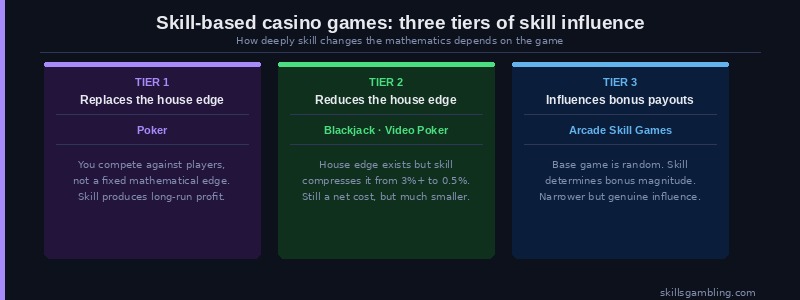
Poker occupies a different category from every other casino game. In blackjack, video poker, and even skill-based arcade games, you’re competing against a fixed mathematical disadvantage — the house edge. In poker, you’re competing against other players. The casino takes only a rake — a fixed fee regardless of who wins.
This structural difference is why poker is unique: a skilled player can generate a genuine long-run profit not by overcoming the house, but by consistently making better decisions than their opponents.
The Skill Stack in Poker
Poker skill is not one thing — it’s a collection of competencies that compound across thousands of decisions:
Position awareness: Acting last on each betting street is a structural information advantage. Skilled players exploit position systematically — playing more hands when they act last, folding more when they act first.
Hand selection: Playing fewer hands from better positions is one of the highest-impact improvements any beginner can make. Most recreational players play too many hands from positions where they have no informational advantage.
Pot odds and expected value: Every call in poker is a mathematical decision. Whether to call a bet on the turn depends on your equity in the hand versus the price the pot is offering. Understanding expected value in gambling decisions is the foundation of every profitable poker decision.
Reading opponents: Most players at most stakes have exploitable tendencies — they fold too often, call too much, or telegraph strength through bet sizing. Identifying and adjusting to these patterns is where significant profit comes from.
Bankroll management: No skill matters if you go broke during a normal variance swing. Professional poker players maintain 20–50 buy-ins at their chosen stake precisely because variance can produce extended losing periods even for genuinely skilled players.
Where Luck Remains in Poker
Which cards you receive is random. Which community cards fall is random. A weaker player beats a stronger player in any individual hand regularly — that’s how poker works. Skill becomes the dominant factor over thousands of hands, not over a single evening.
Video Poker: Where Optimal Play Approaches Zero House Edge
Video poker sits at an interesting point on the skill spectrum — it’s a machine game (like slots) but with genuine strategic depth (like poker). The player receives five cards and decides which to hold and which to discard. The final hand determines the payout.
The critical difference from slots: the correct hold decision for each five-card combination is mathematically calculable. Playing optimally on Jacks or Better (the most common variant) reduces the house edge to approximately 0.46% — among the lowest of any casino game available online or in person.
The Skill in Video Poker
Optimal play requires knowing the correct hold for every possible five-card hand. Some decisions are obvious (hold four cards to a royal flush). Others are counterintuitive — for example, holding a low pair over four cards to a flush in certain situations, because the expected value of the pair exceeds the expected value of the flush draw.
Common mistakes that cost players money:
- Keeping a kicker with a high pair (“protecting” the pair achieves nothing mathematically)
- Always keeping a high card over a low pair (usually wrong)
- Breaking a made hand to chase a straight or flush (often wrong unless the draw is to a royal)
These errors might seem small in isolation. Compounded across hundreds of hands per session, they add percentage points of house edge that don’t need to exist.
Paytable Selection Matters
Not all video poker machines are equal. The same Jacks or Better game can carry house edges ranging from 0.46% to over 5% depending on the paytable — specifically the payouts for Full House and Flush. The “9/6” paytable (Full House pays 9:1, Flush pays 6:1) is the most favourable and carries that 0.46% edge. The “8/5” or “7/5” paytables are significantly worse.
Checking the paytable before you play is non-negotiable. It’s the highest-impact decision in video poker.
The New Generation of Skill-Based Casino Games
Since around 2016, a new category of casino game has emerged — explicitly designed to incorporate genuine player skill into the outcome. These games were developed partly in response to regulatory changes (particularly in Nevada and New Jersey) that created a legal framework for skill-based wagering, and partly to attract a generation of players more accustomed to video game mechanics than traditional slot reels.
How They Work
The most common structure separates the game into two components:
The random component — a base game or jackpot trigger that operates like a standard RNG slot. The player has no influence over when this fires.
The skill component — once triggered, a bonus round where player performance determines the payout magnitude. This might be an arcade-style shooting game, a puzzle, a reflex challenge, or a knowledge-based question.
Better performance in the skill component earns a larger payout within the bonus. The triggering of the bonus remains random.
Examples of Skill-Influenced Casino Games
Trivia and knowledge games: Answer correctly to unlock prizes and multipliers. The Heist is a well-known example — a quiz-based skill casino game where correct answers determine payouts.
Arcade-style games: Shoot targets, navigate obstacles, or complete timed challenges during bonus rounds. Player proficiency at the arcade element determines the bonus amount.
Tournament blackjack and poker: Casino tournaments introduce player-vs-player competition into traditionally house-banked games. Your decisions compete directly against other players’ results, not just against the dealer.
The Honest Assessment
Skill-based casino games are a genuine and growing category — but it’s worth being clear about the limits. The triggering of bonus rounds remains random. The magnitude of bonus payouts is where skill applies. A highly skilled player earns more from bonus rounds than an unskilled one — but both players need the bonus to trigger first, and that’s outside anyone’s control.
The skill influence is real. It’s also narrower than in blackjack or poker. These games are best understood as a meaningful step toward player agency in casino gaming — not a full replacement for the deeper skill dimensions of card games.
Games Often Mistaken for Skill-Based
Intellectual honesty requires being clear about which games are not skill-based, even when they’re sometimes marketed or perceived that way.
Craps
Craps involves complex betting options, some with low house edges (Pass Line at 1.41%, Come bets, Free Odds). Understanding which bets to place — and which to avoid — is genuine knowledge. But the dice outcome is entirely random. No decision you make influences where they land.
Craps is a game of bet selection, not skill in the gambling sense. Choosing the Pass Line over a Proposition bet reduces your house edge — that’s meaningful — but it’s the same type of skill as choosing European over American roulette. It minimises cost; it doesn’t create edge.
Baccarat
Baccarat has almost no skill dimension. The rules dictate drawing and standing automatically. Your only decision is where to bet: Banker (1.06% house edge), Player (1.24%), or Tie (14.4%). Always bet Banker. That’s the entirety of baccarat strategy. How the house edge works in baccarat and other casino games explains why this small skill decision still leaves a permanent mathematical disadvantage.
Slots
Standard slot machines are pure RNG outcomes. Every spin is independent. No decision influences what symbols appear. Limited skill applies to game selection (choosing higher-RTP slots), stake sizing, and bankroll management — but none of these decisions affect the outcome of any individual spin.
How Much Does Skill Actually Matter?
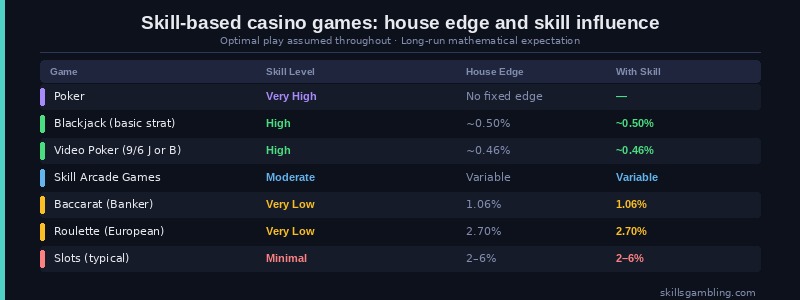
Here’s an honest summary of where skill genuinely lives across casino games:
| Game | Skill Influence | House Edge (Optimal Play) | Long-Run Profit Possible? |
|---|---|---|---|
| Poker | Very High | Variable (rake only) | Yes |
| Blackjack (basic strategy) | High | ~0.5% | No (marginal with counting) |
| Video Poker (optimal) | High | ~0.46% | No (marginal) |
| Skill-Based Arcade Games | Moderate | Variable | No |
| Craps (bet selection) | Low | 1.06–1.41% | No |
| Baccarat (Banker) | Very Low | 1.06% | No |
| Roulette (game selection) | Very Low | 1.35–2.70% | No |
| Slots | Minimal | 2–6% | No |
The pattern is clear. Skill reduces the house edge in blackjack and video poker, and replaces the house edge in poker. Everywhere else, skill influences how much you lose — not whether you lose over time.
Whether skill can ever fully overcome the house edge is a question worth exploring in detail — the honest answer is more nuanced than most gambling guides admit.
Responsible Gambling
No casino game strategy guarantees profit. All gambling involves financial risk. Past results do not predict future outcomes.
Skill improves your long-run mathematical position in blackjack, poker, and video poker. It does not guarantee winning sessions, eliminate variance, or remove the possibility of significant losses over any period of time.
If gambling stops feeling like entertainment and starts feeling compulsive — or if you’re playing to recover losses rather than for the game itself — please use these resources:
- GamCare (UK): gamcare.org.uk / 0808 8020 133 (free, 24/7)
- BeGambleAware: begambleaware.org
- GAMSTOP (UK self-exclusion): gamstop.co.uk
- National Problem Gambling Helpline (US): 1-800-522-4700
FAQ
Which casino game has the highest skill influence?
Poker has the highest skill influence of any casino game because you compete against other players rather than a fixed house edge. Better decisions produce better long-run results consistently and measurably — the same players win at the highest levels year after year. Among house-banked games, blackjack with basic strategy and video poker with optimal play offer the highest skill influence.
Can skill eliminate the house edge in blackjack?
Basic strategy reduces the house edge to approximately 0.5% but does not eliminate it. Card counting can theoretically produce a small player edge under the right conditions — but requires significant skill, practice, and access to games with sufficient penetration, which is increasingly difficult in modern casino environments.
Is video poker better than slots?
From a mathematical standpoint, yes — significantly. Optimal video poker play on a 9/6 Jacks or Better machine carries a house edge of approximately 0.46%. Most slots carry house edges of 2–6%. The trade-off is that video poker requires genuine skill investment to achieve that low edge; playing video poker poorly can be worse than playing a mid-range slot correctly.
Are skill-based slot machines worth playing?
Skill-based slot machines offer a genuine improvement for players who excel at the skill component — better bonus performance earns larger payouts. The random triggering element means the base game economics still apply, and the skill influence is narrower than in blackjack or poker. They’re a legitimate category worth understanding, particularly for players who find traditional slots passive.
What is the easiest skill-based casino game to learn?
Blackjack basic strategy is the easiest to learn with the most direct mathematical impact. The core principles can be functional within a few hours of study. A printed strategy card is permitted at most casino tables while you’re learning. The improvement in expected outcome is immediate and measurable.
Does poker count as a casino game?
Poker is available in casinos but operates differently from house-banked casino games. You’re competing against other players, not the house. The casino earns revenue from rake rather than a mathematical edge on your bets. This structural difference is precisely why poker is the clearest example of a game where skill produces genuine long-run profit for skilled players.
Conclusion
Skill-based casino games are not a myth — they’re a specific, identifiable category of gambling where better decisions produce better outcomes over time. The evidence is mathematical, not anecdotal.
Blackjack rewards players who learn basic strategy with one of the lowest house edges in any casino. Poker rewards players whose decisions consistently outperform their opponents. Video poker rewards players who hold the correct cards every hand. The new generation of arcade-style skill games rewards players whose performance in bonus rounds exceeds the average.
What connects all of these is the same principle: your decisions matter. Not in every hand. Not in every session. But measurably, over time, in ways that compound into real differences between informed and uninformed players.
That’s the case for skill-based casino gaming. It’s not that skill guarantees profits — it’s that skill genuinely changes the mathematics. And understanding where and how it does that is the starting point for every decision worth making at a casino table.
Related Reading
- Blackjack Basic Strategy Chart: The Definitive Guide
- Online Blackjack: How to Cut the House Edge to Under 1%
- Online Poker Strategy: The Definitive Guide
- Can Skill Overcome the House Edge?
- House Edge Explained: What It Is and How It Works
- Expected Value in Gambling: The Complete Guide
- Skill vs Luck: What Actually Determines Your Results
SkillsGambling.com is an educational resource. Nothing published here constitutes financial advice or a guarantee of gambling outcomes. Gambling involves financial risk. Please gamble responsibly. 18+ only.